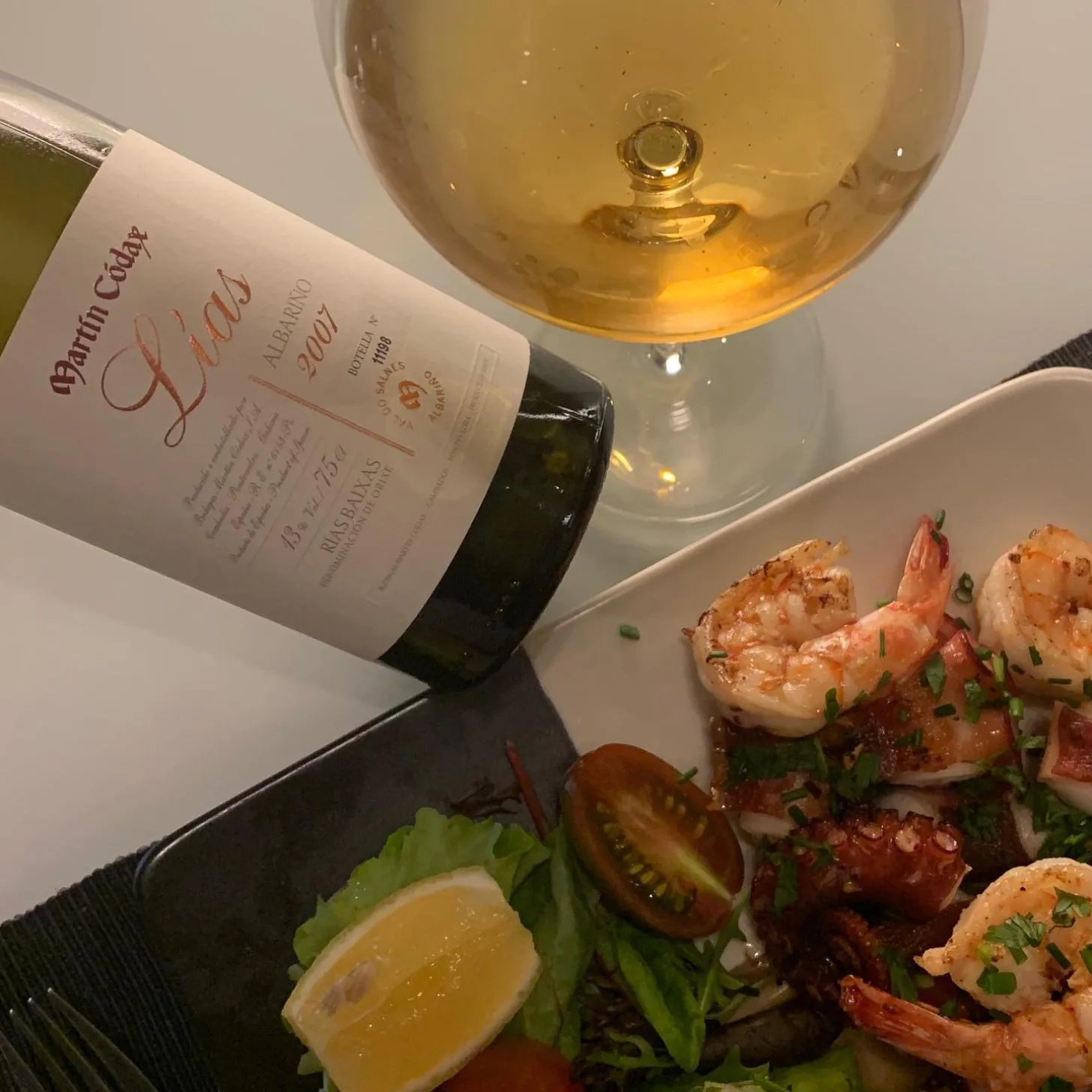
Do you really need to decant a 14-year-old Albariño? To be honest, I never planned to find out. Opening a bottle of 2007 Bodegas Martín Códax Lías was supposed to be a quiet tribute to one of the most legendary names in Spain’s Northwest. Founded as a cooperative in 1986, Martín Códax is more than a winery—it is the soul of the DO Rías Baixas.
This specific bottle hails from the Val do Salnés sub-region, the birthplace of the Albariño grape. Here, the vineyards sit on ancient granitic soils, constantly lashed by the Atlantic winds. The “Lías” bottling is a masterclass in patience; by aging the wine on its fine lees, the winery transforms a high-acid coastal white into a structured, age-worthy powerhouse. But even the legendary craftsmanship of Salnés couldn’t save a tired cork.
The moment my corkscrew made contact, the cork surrendered. It disintegrated into a fine, woody dust, right into the neck of the bottle. Without a Durand corkscrew at hand to rescue this 14-year-old “grand dame,” I was left with a messy dilemma: drink a “cork soup” or go for a forced experiment. I chose the latter and transferred the wine into a decanter through a strainer.
My biggest fear was that this fragile white would simply vanish—that its delicate Atlantic spirit would oxidize and die. I poured the first glass immediately, expecting a fading ghost, but to my surprise, the wine felt tightly coiled, even stubborn. It was as if the granite of its terroir was still holding it together.
As I watched it evolve over the next 30 to 40 minutes, something incredible happened. It didn’t just survive; it bloomed. The once-sharp, salty acidity had mellowed into a sophisticated, silky texture of dried citrus peel, toasted hazelnuts, and a haunting hint of aged honey. It was a reminder that a well-made Albariño doesn’t just grow old—it gains wisdom. Sometimes, an epic cork failure is exactly what you need to force a great vintage to reveal its true, hidden character.
Pairs well with