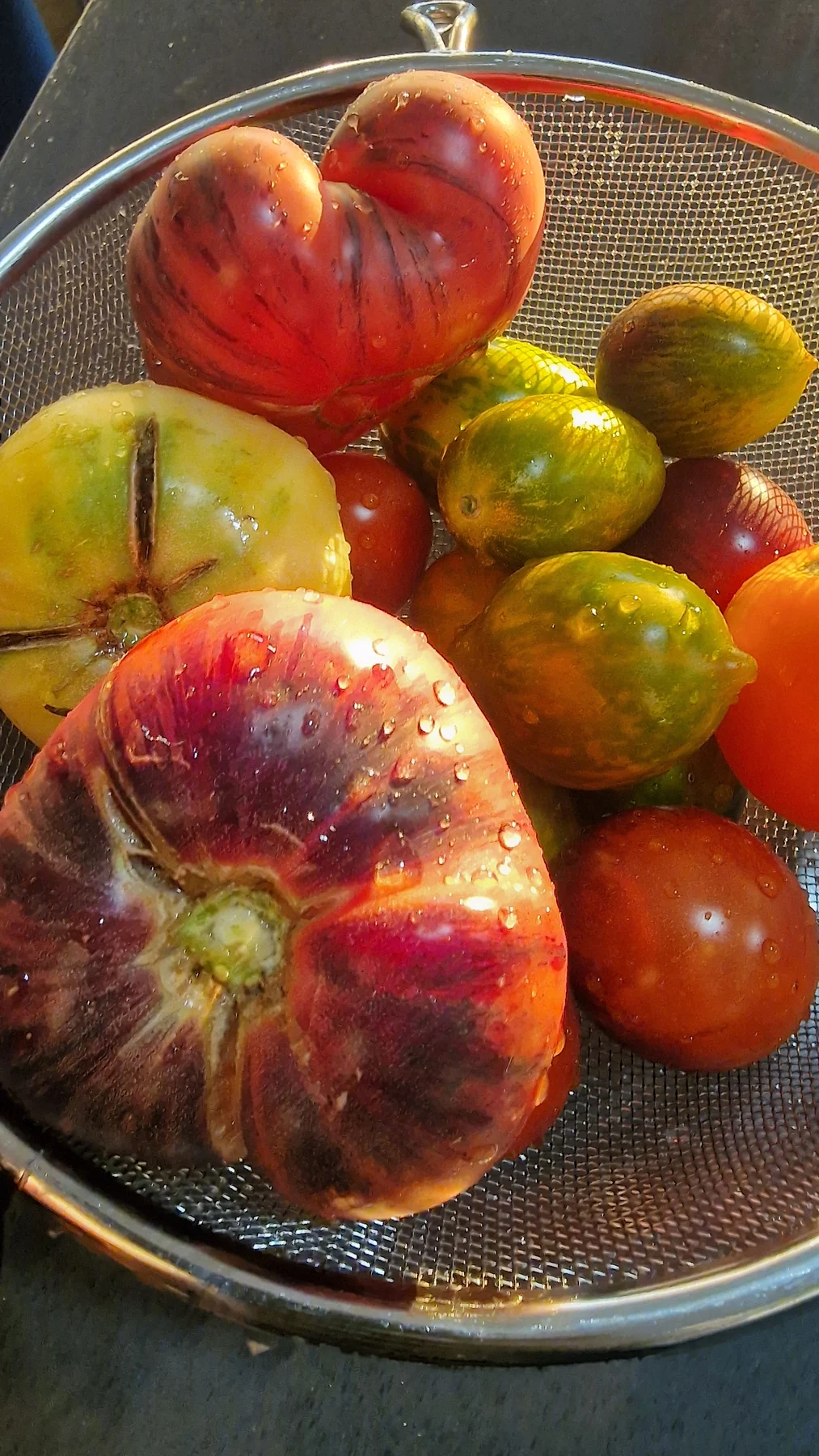
Kalenić market opened in 1926, the year Belgrade closed its central Great Market and moved trade out to new markets away from downtown. The lot had belonged to Vlajko Kalenić, a wealthy benefactor, and before it held stalls it was a threshing floor, Kalenića gumno, Kalenić's threshing ground. Under the German occupation the city cut it into vegetable plots for its clerks, which is one way to keep a market supplied. A reconstruction that began in 2016 has been criticised, re-planned and re-announced in phases ever since, and none of it has changed the basic arrangement: this is where Vračar buys what it eats. On that Saturday in the early days of August, my fiancée and I did what had recently become our routine: a walk to Kalenić market for fresh produce, then a stop at Le Nonne Pasta Fresca, then a look at what Volver, next door on Mileševska, had to offer in local wine.
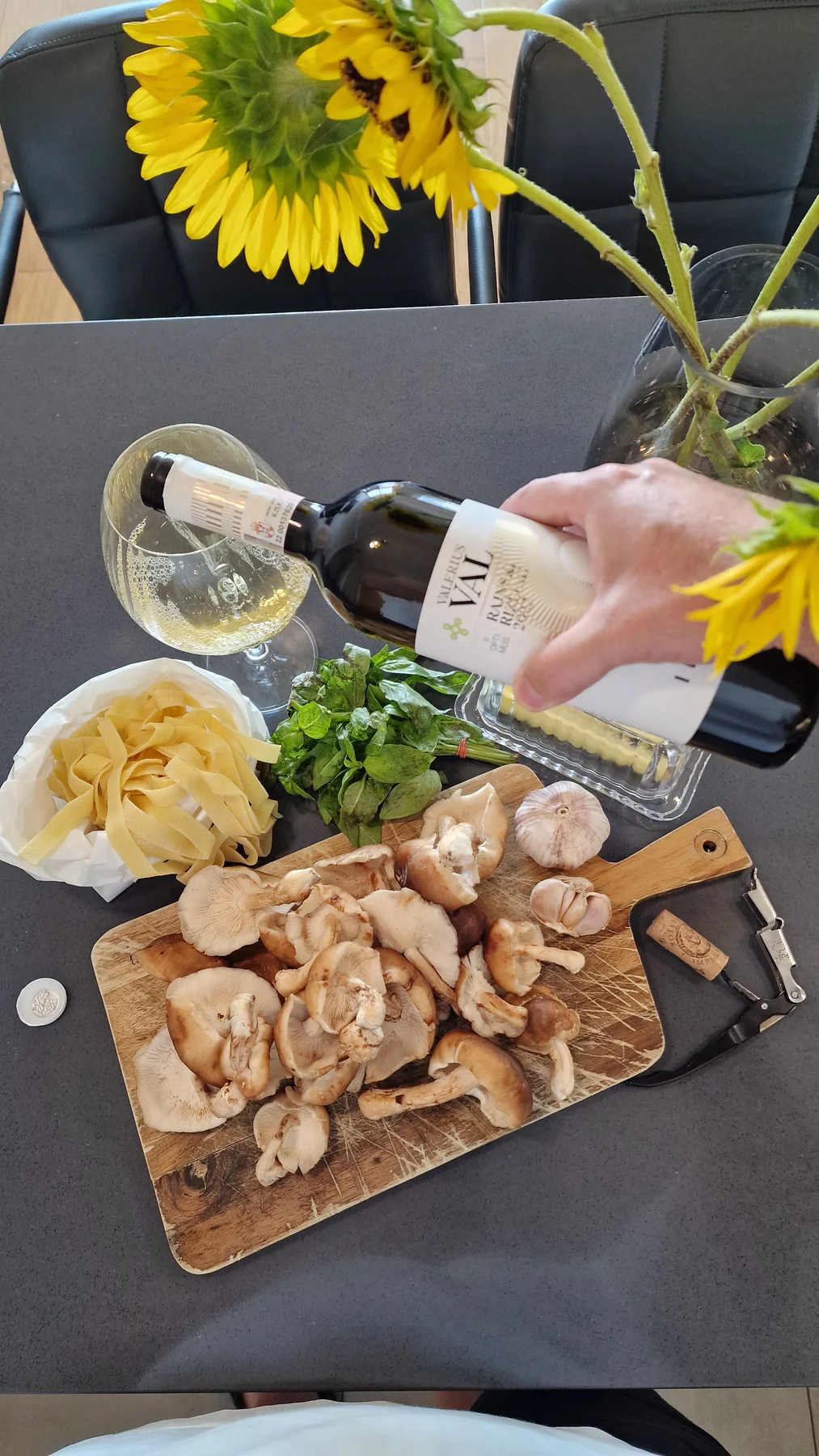
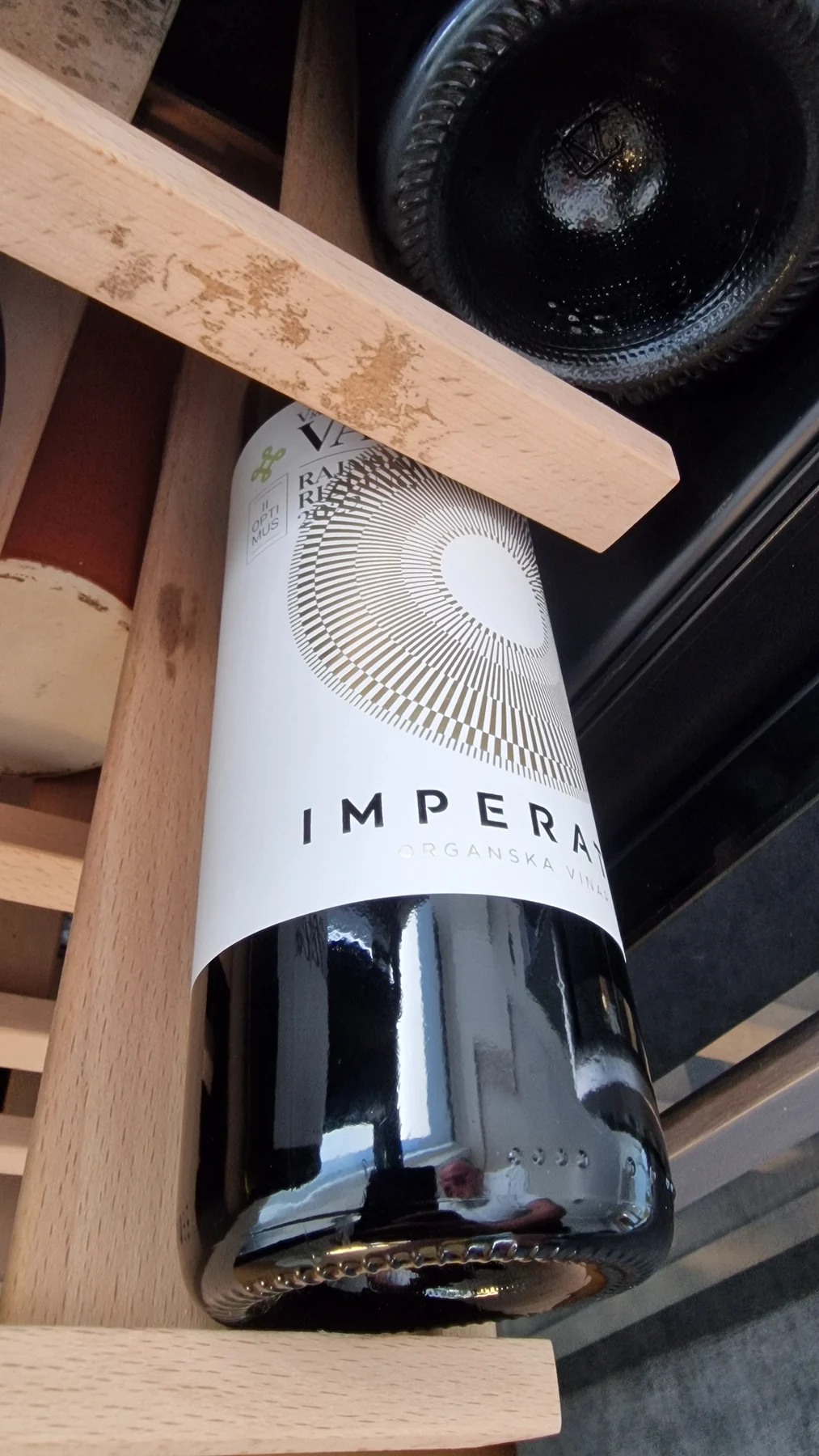
For most of the summer, lunch at home has been a running experiment with pasta fresca, fresh rather than dried, always pappardelle: seafood one week, asparagus another, one kind of mushroom after another, and a different wine in the pan each time. That Saturday it was oyster mushrooms with garlic, spinach and cream. The variable was a Riesling from Fruška Gora, the low ridge between the Danube and the Sava that closes the northern horizon of Serbian wine. I chose it on a narrow argument. A pan sauce wants a white wine that is dry, high in acid and untouched by oak, and in Serbia the grape that meets all three conditions most reliably is also the easiest to confuse with something else. Rajnski rizling, Rhine Riesling, is the real thing. Italijanski rizling, also sold as grašac, is Welschriesling, an unrelated variety and by far the more widely planted "Riesling" of Fruška Gora. Read the label carelessly and the experiment tests the wrong grape.
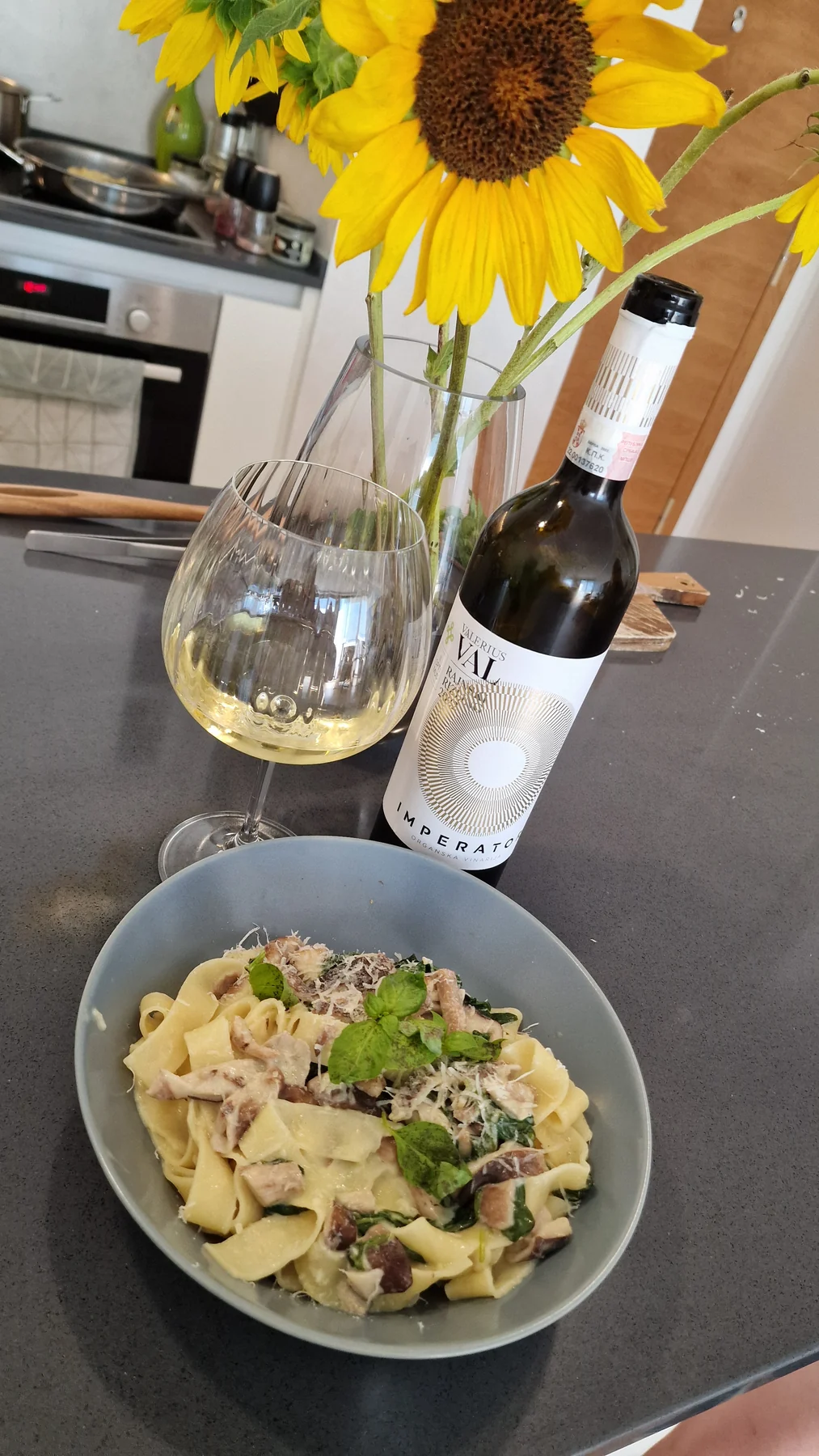
The producer, Imperator, gives Sremska Mitrovica, the Roman Sirmium, as its company address on the back label and names its wines after emperors born in the region. The conceit is less arbitrary than it sounds. Sirmium was one of the four capitals of the Tetrarchy, Diocletian's late-third-century arrangement of two senior and two junior emperors ruling the empire in quarters, and the surrounding province supplied emperors at a rate few others matched. Valerius was the name the whole generation took on: all four original tetrarchs carried it, and Maximian, one of them, was born near Sirmium around 250. The label does not say which Valerius it means. The region's founding legend belongs to another son of the city. Probus, emperor from 276, is credited with ordering his soldiers to plant vines on Fruška Gora around 280. In 282 his own troops killed him near Sirmium, by the traditional account because he kept them at farm labour, draining marshes, and had remarked that the empire would soon have no need of soldiers. A winery that takes Roman emperors as patrons has picked a profession with a high rate of workplace accidents.
The decision that sets Imperator apart is in the vineyard. The estate has been certified organic by Ecocert since 2015 and biodynamic by Demeter, the certification body for biodynamic farming, since 2021. Biodynamics is the system Rudolf Steiner outlined in a 1924 lecture course for farmers at Koberwitz in Silesia: organic farming plus a planting calendar and a set of preparations, fermented manure and herbal composts, that sceptics treat as folklore and adherents treat as method. The 2021 Claudivs, Valerius and Gratianus were reported as the first Serbian wines to carry the Demeter logo. The cost is practical rather than philosophical. Against mildew an organic grower may use copper and sulphur and very little else, on a plain where the neighbours have the full chemical arsenal. The team the producer names is a technical one: Đurđa Katić, a graduate technology engineer, runs grape and wine production, Jovica Urošević works the cellar, and Miloš Marković is responsible for organic practice in the vineyard.
The vineyard is a single 9.3-hectare estate at Netin kraj near Erdevik, a village in the south-western foothills of Fruška Gora, at 146 to 164 metres. The winery sits at Rakovac on the Danube side of the ridge, so the grapes cross the mountain before they meet a tank. By the producer's account the Riesling faces south, at 164 metres, on gajnjača, the local name for a brown forest soil (eutric cambisol in the international classification), over loess, the wind-blown glacial silt that covers much of the Pannonian plain. This is terroir pulling against the grape's reputation. Riesling made its name in cool river valleys, on steep slopes where every hour of sun counts. A low, south-facing site in Srem, where grapes ripen earlier and reach roughly two percent more sugar than elsewhere in northern Serbia, pushes it the other way: riper yellow fruit, quince and honey, a fuller body, and an earlier arrival of the petrol note, which comes from TDN (trimethyl-dihydronaphthalene), a compound formed from the breakdown of carotenoids in the skins that increases with sun on the bunches. What keeps the wine from going heavy is the variety's acidity, which survives heat better than its aromatics do. In a dry year the loess matters more than any of this. It is deep, and it holds water and gives it back slowly. One detail is unresolved: the producer dates the Riesling planting to 2018, while vino.rs reported in January 2023 that the 2021 Valerius came from the original vineyards of 2009. If the producer is right, the 2022 crop came from vines in their fourth leaf.
2022 tested both the soil and the young roots. The Serbian hydrometeorological service ranked it the second-warmest year since national records began in 1951. Novi Sad, on the far side of the mountain, ran 1.4°C above the 1991–2020 average, and Belgrade counted 65 tropical days, days above 30°C, 25 more than normal. The heat came early: the north of the country went through a heat episode from 12 to 17 May, in the run-up to flowering. Summer was Serbia's third-warmest on record, with four heat waves and a national peak of 40.6°C on 23 July. The dryness did more damage than the heat. From May to August conditions came close to the 2017 drought, one of the worst on record, and total agricultural losses were put at nearly a billion dollars. Drought is the one stress an organic grower can almost welcome, since dry leaves do not get mildew, and it is also the one young vines with shallow roots handle worst. The producer has published no harvest date, yields or analysis for 2022. The structure shows on the label: 13.0% alcohol, a full point above the 12% on the producer's own product page, in a wine labelled dry. I trust the bottle in hand. A hot year on a warm site gave a Riesling with weight, which is exactly what a cream sauce asks for.
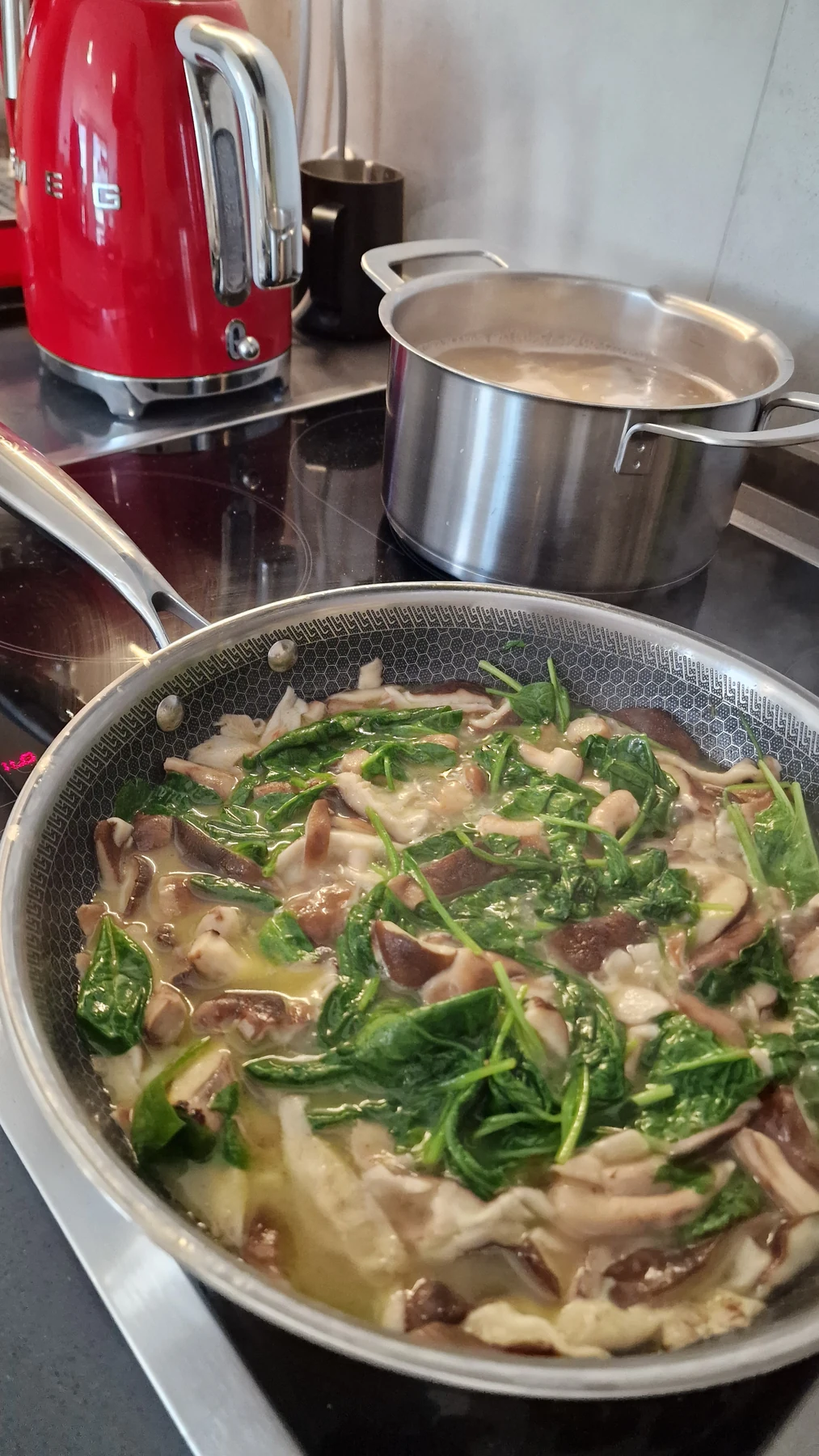
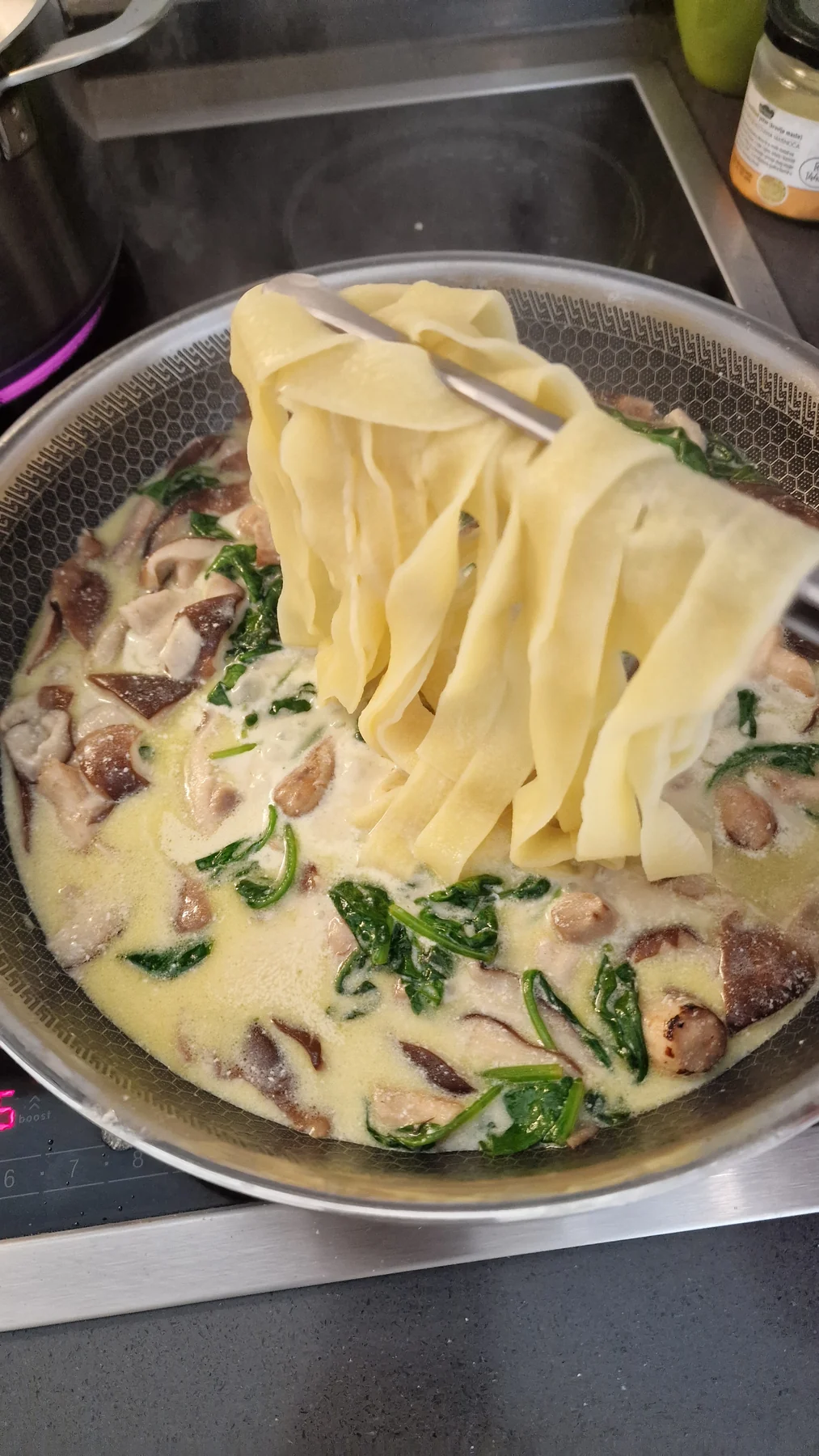
The case for this wine in this pasta is mostly chemistry. The mushrooms went into the pan first with the garlic, to brown; the wine went in next, to lift the browned layer off the steel and reduce; then the spinach, and the cream last. Reduction is selective. Water and most of the aromatics leave, while acids and the rest of the extract stay. Riesling's acidity is largely tartaric and malic, and neither evaporates, so reducing a glass by half roughly doubles its acid concentration. In a cream sauce that acidity does the job a squeeze of lemon would do: it cuts the fat, so the last forkful is as light as the first. Dryness matters for the same reason, because residual sugar concentrates too, and an off-dry Kabinett, the lightest of the German ripeness grades and often made with a little sweetness left in, would have left the sauce faintly sugary. The élevage matters for the same kind of reason: the wine was raised in stainless steel with no oak, and oak tannin and the toasted compounds from a barrel turn bitter when a wine is reduced, so a steel-raised Riesling leaves nothing bitter behind in the pan. The order matters as well. Wine goes in before cream, and heavy cream at around 35% fat tolerates acid where milk would split. The honey, quince and petrol on the label mostly do not survive the pan. What survives is structure, and it is the same structure that is in the glass. That is the real argument for drinking what you cook with. The sauce already carries the wine's acidity, so the wine on the table meets it as a continuation rather than a contrast, and the honeyed ripeness of a warm-year Riesling sits easily against the earthy sweetness of browned mushrooms and the grated cheese on top.
The strip on the back label says this was bottle no. 400 of 2,100, the kind of number that usually sends a bottle to the cellar rather than the stove. Kitchen economy says cook with something cheap and drink something good. Bottle no. 400 gave one glass to the pan and the rest to the table. Neither side complained.
Pairs well with