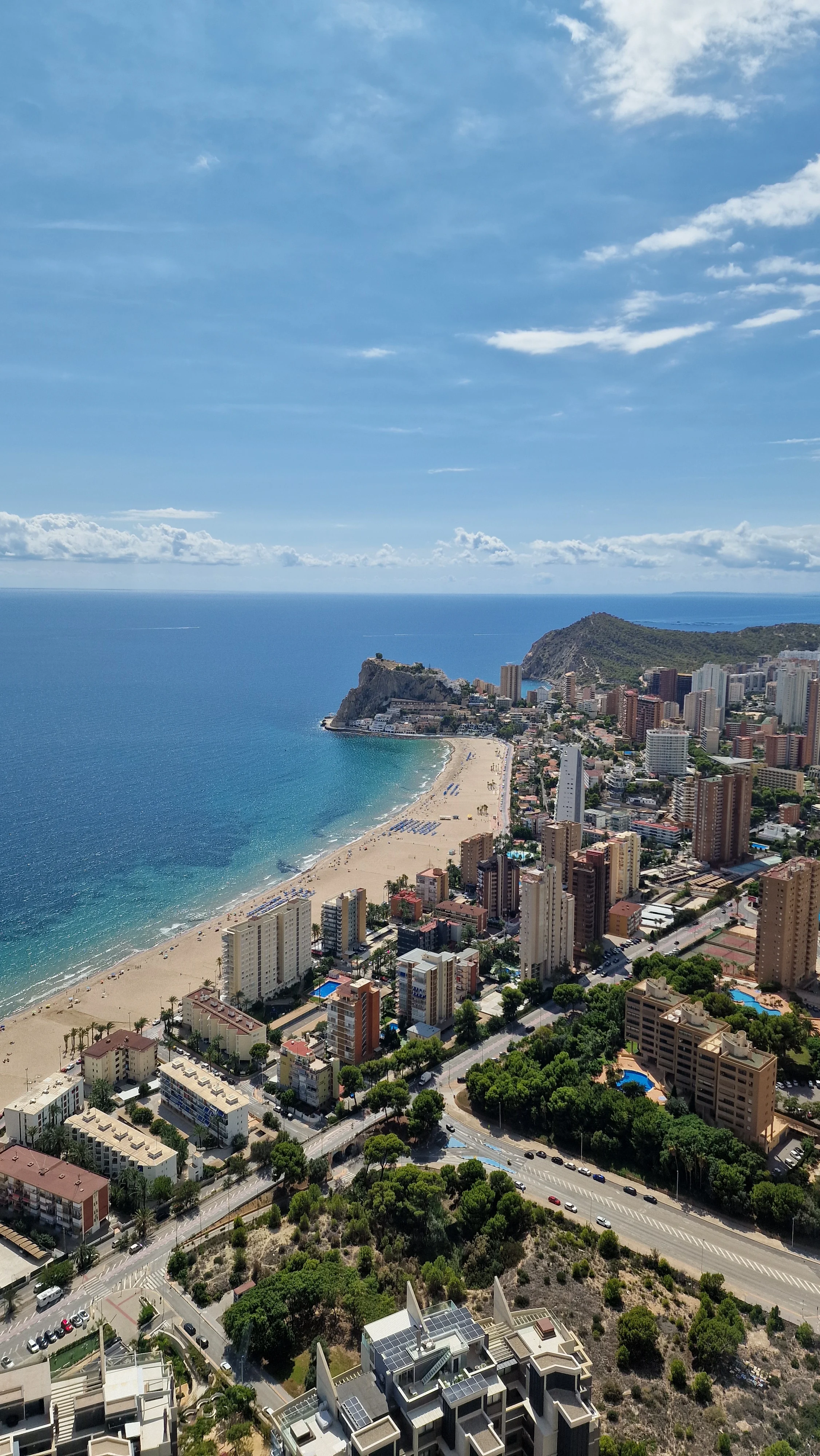
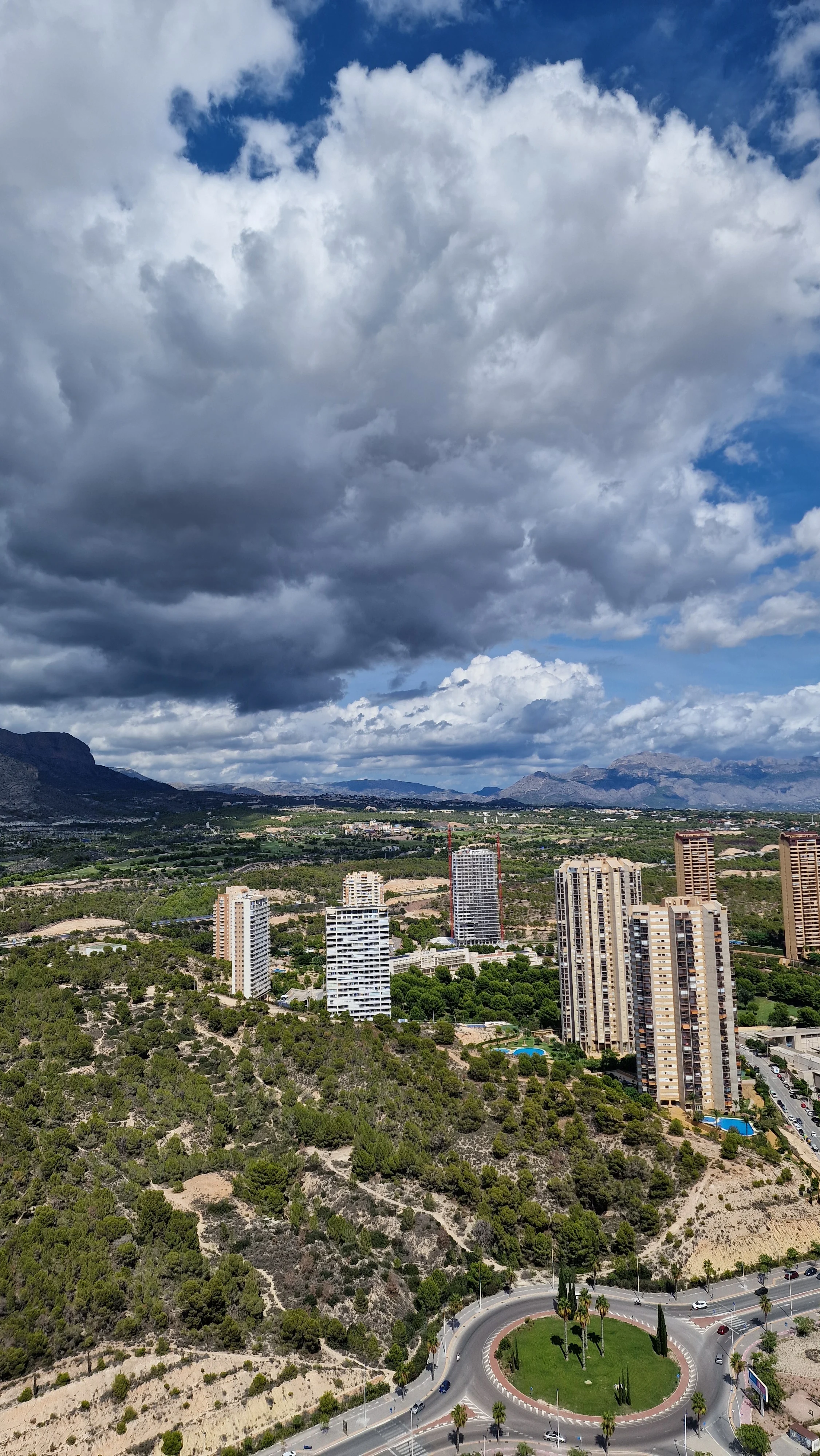
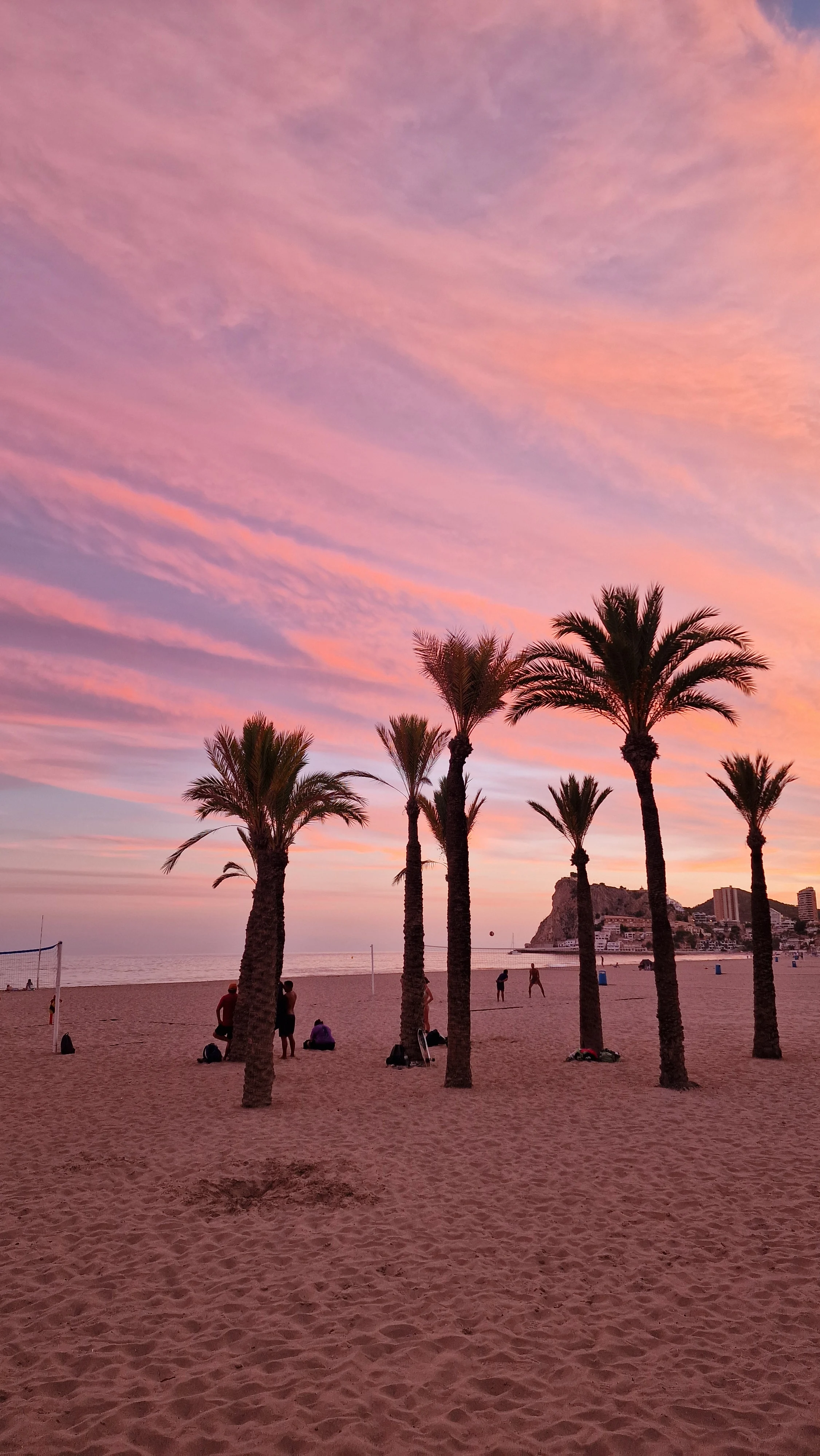
We took an apartment on the 37th floor of the Intempo for a month — mid-September to mid-October, the window when Benidorm hands itself back to the people who actually like it. The crowds thin, the sea stays warm, and the view from that height was, plainly, the best I have had from any living room, rented or owned. Below the terrace the three-kilometre arc of Poniente — “setting sun,” which is what the beach faces — swept west toward the rock of the old town; the Mediterranean lay flat to the horizon, wide enough to watch weather arrive an hour before it did; inland, beyond the roundabouts, rose the bare limestone sierras, hooded in cloud by morning and stripped clean by noon. In the evening the sky over the sand went pink without any assistance. All of it is the Costa Blanca — the “White Coast,” a name coined not by geographers but by British European Airways in 1957, to sell London its new route to Valencia. My fiancée claimed the sunset end of the terrace on the first evening and never gave it back.
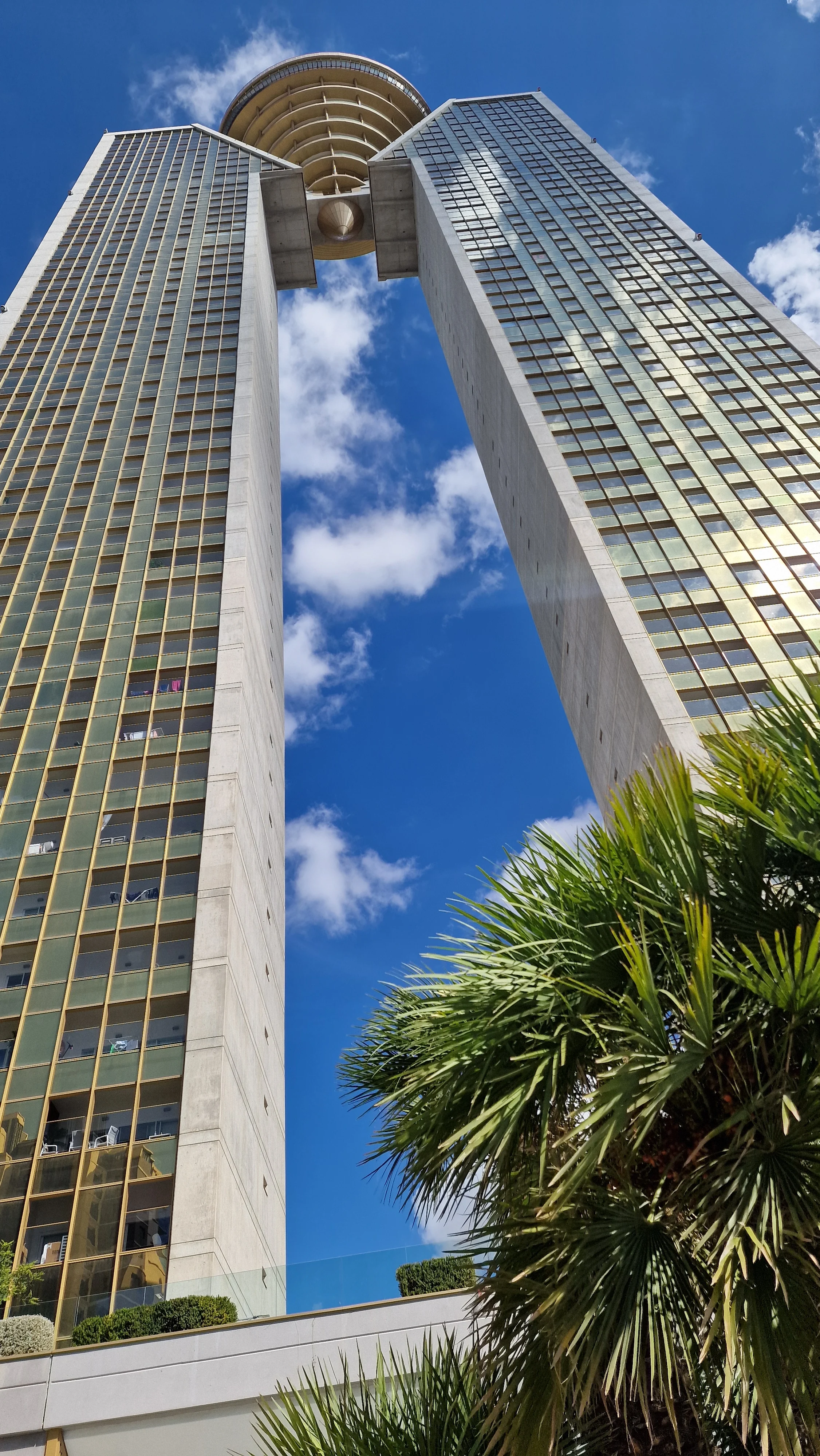
The building earns its digression. The Intempo is two parallel towers of 47 floors joined between the 38th and 44th by an inverted golden cone — we lived one storey below the point where the towers become one building. At 202.5 metres it is the tallest residential building in the European Union, planted in a resort town of seventy thousand. Presented in 2006, at the precise top of Spain’s construction fever, it was scheduled for 2009 and instead consumed fifteen years: the builder went bankrupt, the developer followed it into insolvency, the architects resigned with a fifth of the work unfinished, and the largest creditor ended up being Sareb — the “bad bank” the Spanish state created to warehouse the wreckage of the crash. An American fund bought the tower in 2018 and finished it in 2021. We were living, in effect, on the 37th floor of the Spanish property bubble — completed, furnished, and with excellent water pressure.
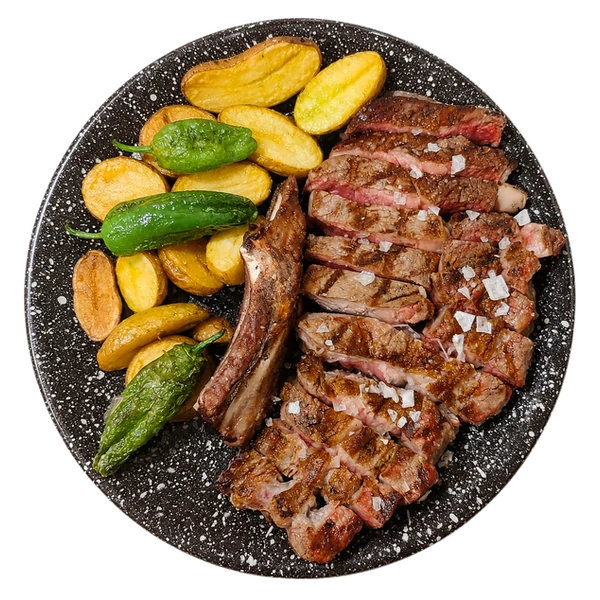
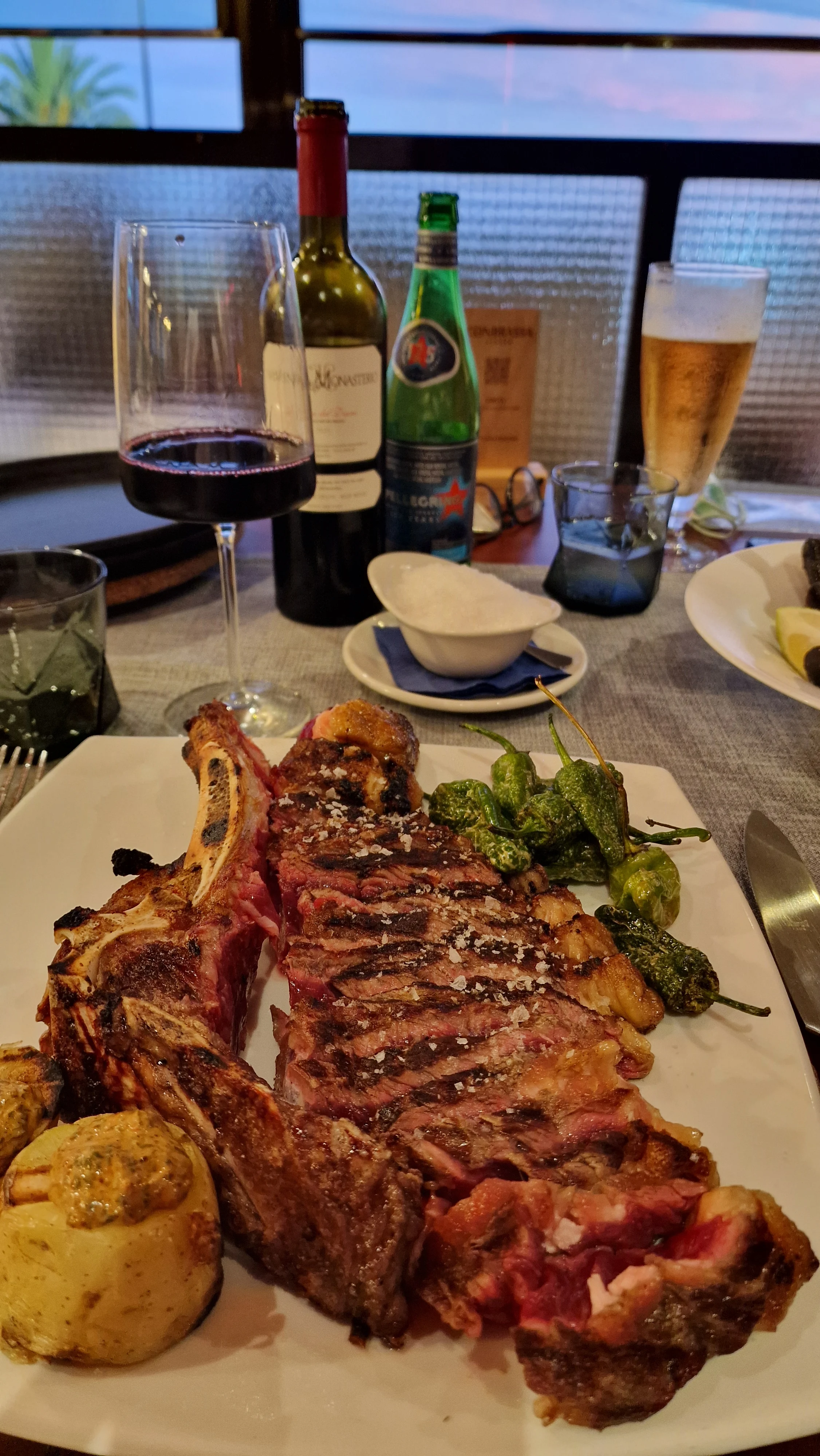
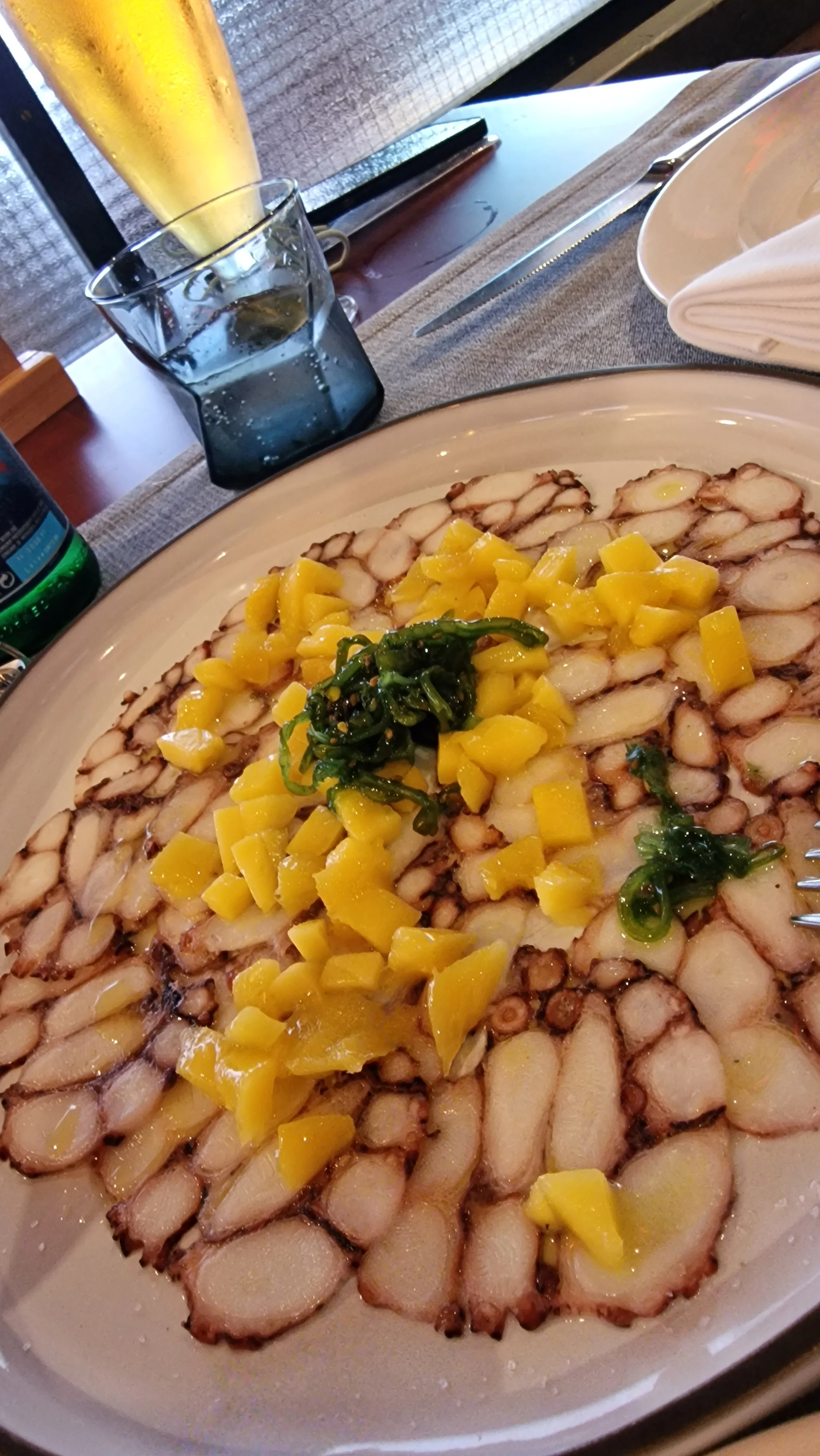
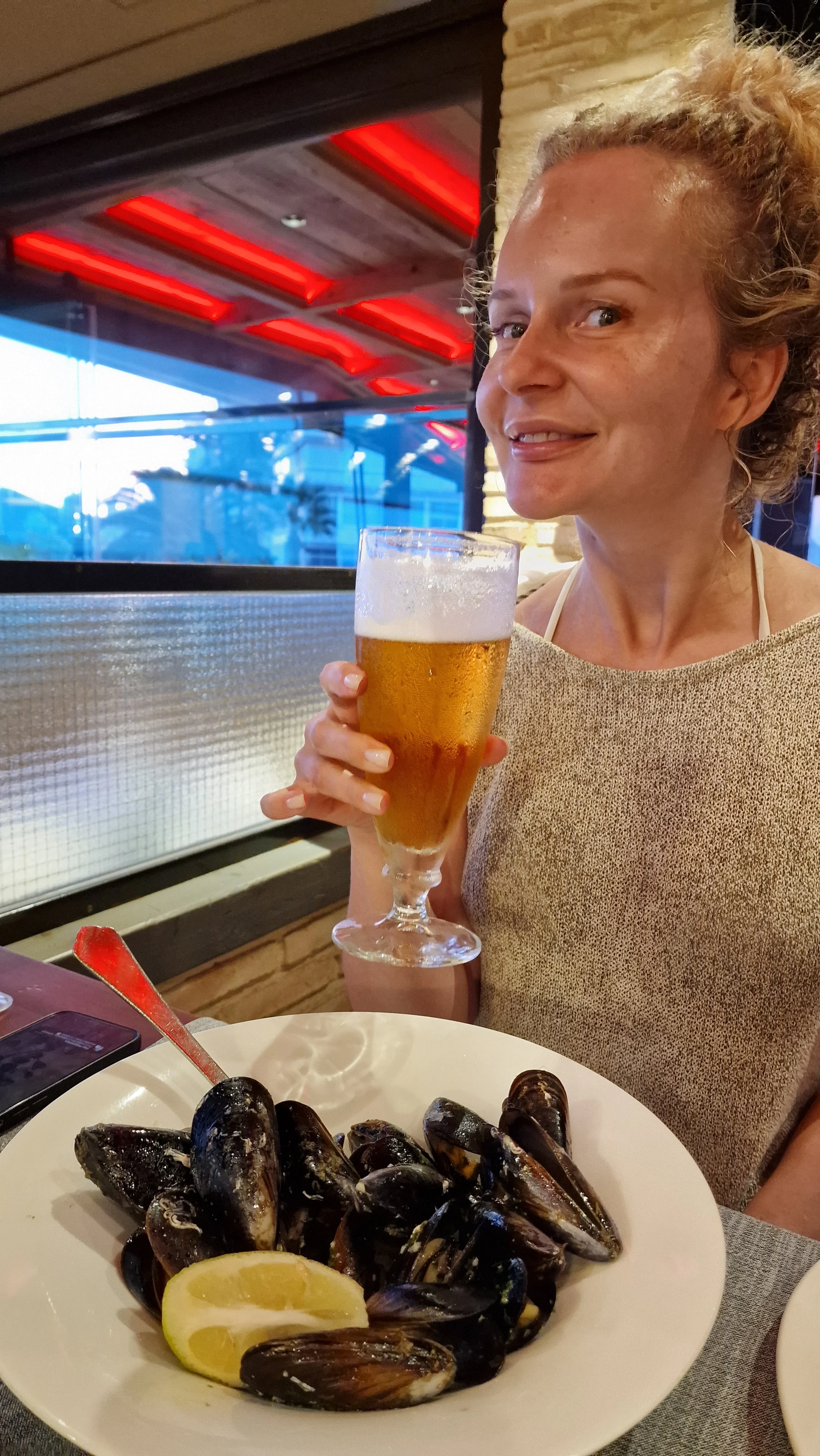
Five hundred metres along the Poniente promenade stood ConBrassa — from brasa, ember — a charcoal grill house directly on the sand. One evening in late September we walked down for the serious version of dinner: mussels and an octopus carpaccio to start, then the reason we had come — chuletón de vaca vieja, a bone-in ribeye from an old cow, the Spanish conviction that beef, like wine, improves with age — flame-grilled and served with padrón peppers. A plate like that narrows the wine list on its own. Rendered fat and char-grilled protein want tannin with acidity behind it, and in Spain that specification reads Ribera del Duero. The list offered the estate wine of Hacienda Monasterio, and the deliberation ended there.
Hacienda Monasterio was founded in 1991 on the so-called Golden Mile — the stretch of the Duero between Pesquera and Valbuena de Duero that also houses Vega Sicilia and Dominio de Pingus. Peter Sisseck — the Dane who would later create Pingus, Spain’s most expensive red — arrived that same year to plant the vineyards and has directed the winemaking ever since; Monasterio is his longest argument, and a contrarian one. While Ribera spent two decades competing on extraction, ripeness and new French oak, Sisseck moved the estate the opposite way: certified organic farming, fermentation on native yeasts, whole berries with a share of stems, macerations held to about twenty days, and barrels that got larger and older as everyone else’s got smaller and newer. “The era of high alcohol is over,” he has declared publicly. The wine we ordered carries fifteen per cent — a contradiction, it would seem, until you look at where it grows.
The estate’s vines stand at about 730 metres on chalky clay-limestone slopes — a terroir whose entire mechanism is continental brutality moderated by altitude. Days scorch; nights turn cold enough to shut the vines down; that diurnal swing is what keeps acidity alive in fruit ripe enough to reach fifteen degrees. The chalk delivers power by default, so all the effort — organic viticulture, low yields, strict selection — is aimed at restraint. Tinto Fino, the local strain of Tempranillo — the name a diminutive of temprano, “early,” for its habit of ripening ahead of everything else — makes up 80 per cent of the blend, with 10 per cent Cabernet Sauvignon, 8 Merlot and 2 Malbec, the Merlot scheduled to disappear entirely in future vintages. The property has mapped twelve distinct soil types across its holdings, and 2019 was the first vintage in which fruit was selected soil by soil and fermented in separate lots, in a new 10,000-litre oak vat bought for exactly that purpose.
The 2019 season justified the trouble. A dry winter and an orthodox spring; frosts on the 4th and 6th of May that did no damage, and — far rarer — a sub-zero morning on the 11th of June that also spared the crop; a dry summer whose few rains arrived at useful moments; harvest at normal dates, of small, thick-skinned berries in perfect sanitary condition. Yields came in low and concentration high, and the Consejo Regulador — the appellation’s governing body — graded the year Excelente, a mark it does not hand out casually. The élevage that followed ran eighteen months in French oak, only about a quarter of it new and a growing share of it in 500-litre casks: long enough to polish the tannin, restrained enough to leave no fingerprints. Bottled in June 2021 — 182,666 bottles.
At the table it did the mechanical work it was engineered for. Tannin bound to the chuletón’s protein and scrubbed the rendered fat; the acidity those cold nights preserved kept fifteen per cent from sitting heavy; tobacco and cocoa in the lower register lined up with the char; dark fruit absorbed the padróns’ bitter edge. No poetry was required — the wine held its structure against a plate designed to overwhelm.
A tower that needed fifteen years to find its balance. A wine that preaches restraint at fifteen degrees. A town that put excess on a grid and made it work. From the 37th floor, they spent a month looking at one another and found nothing to argue about.
Pairs well with