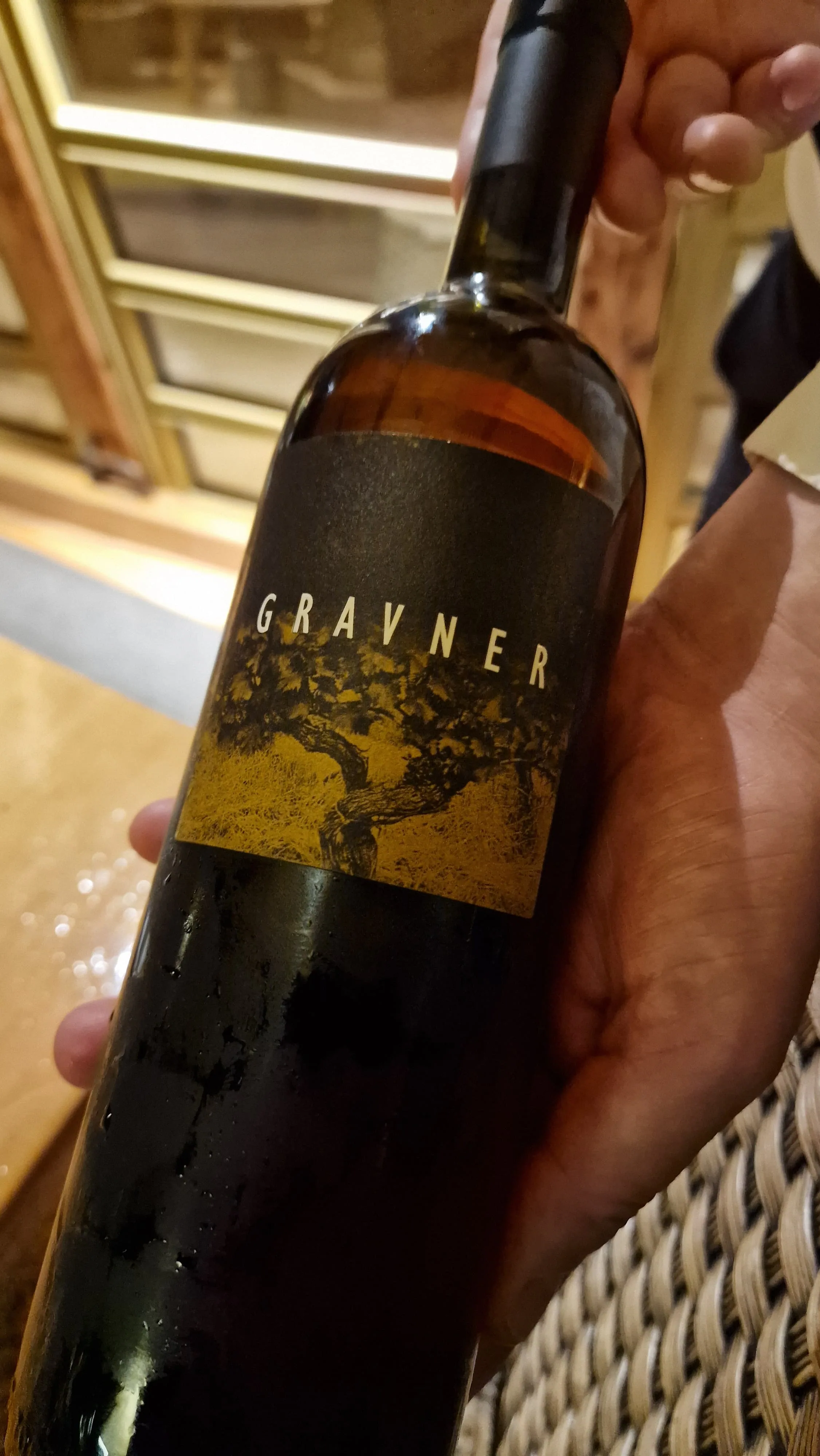
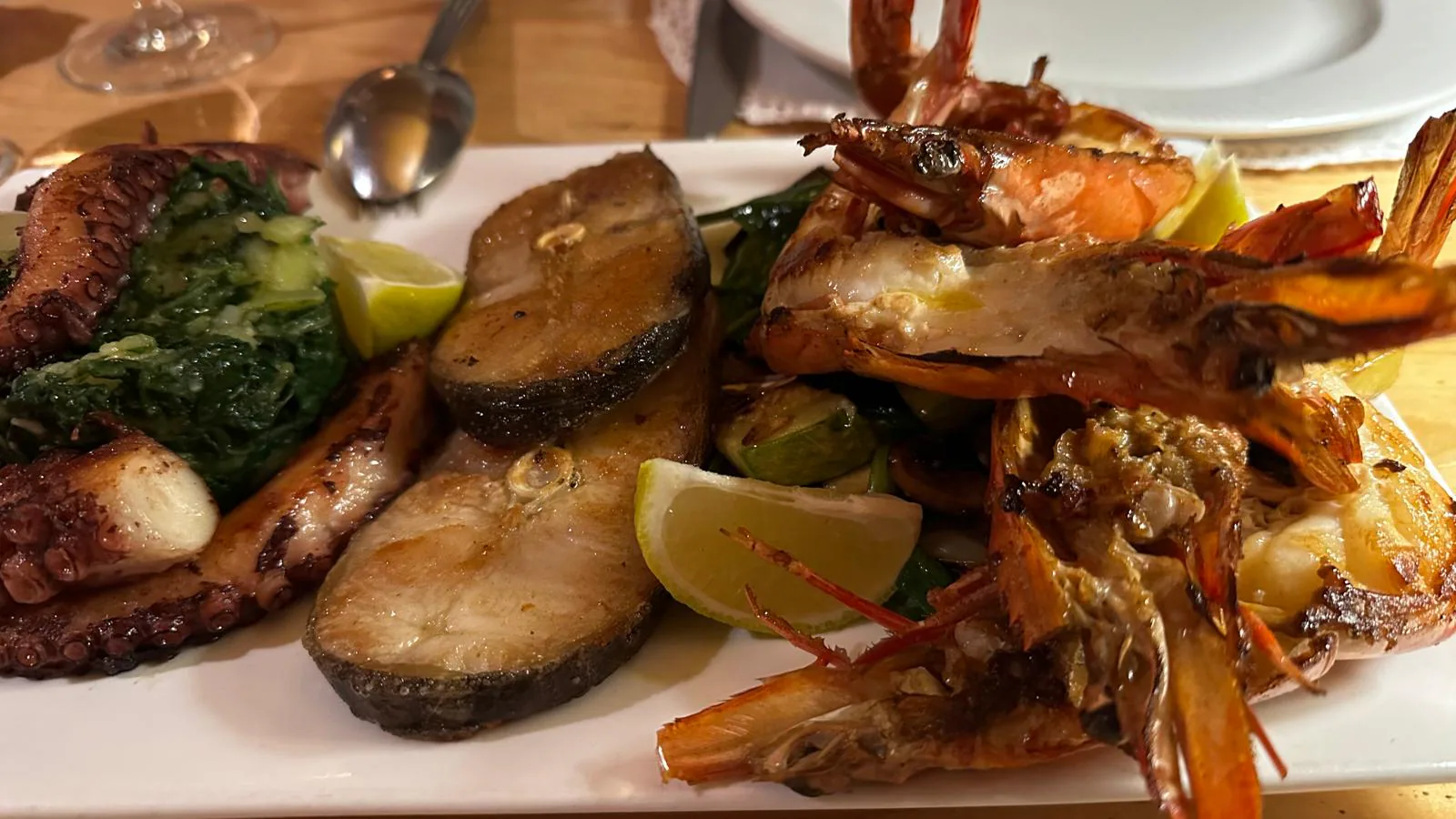
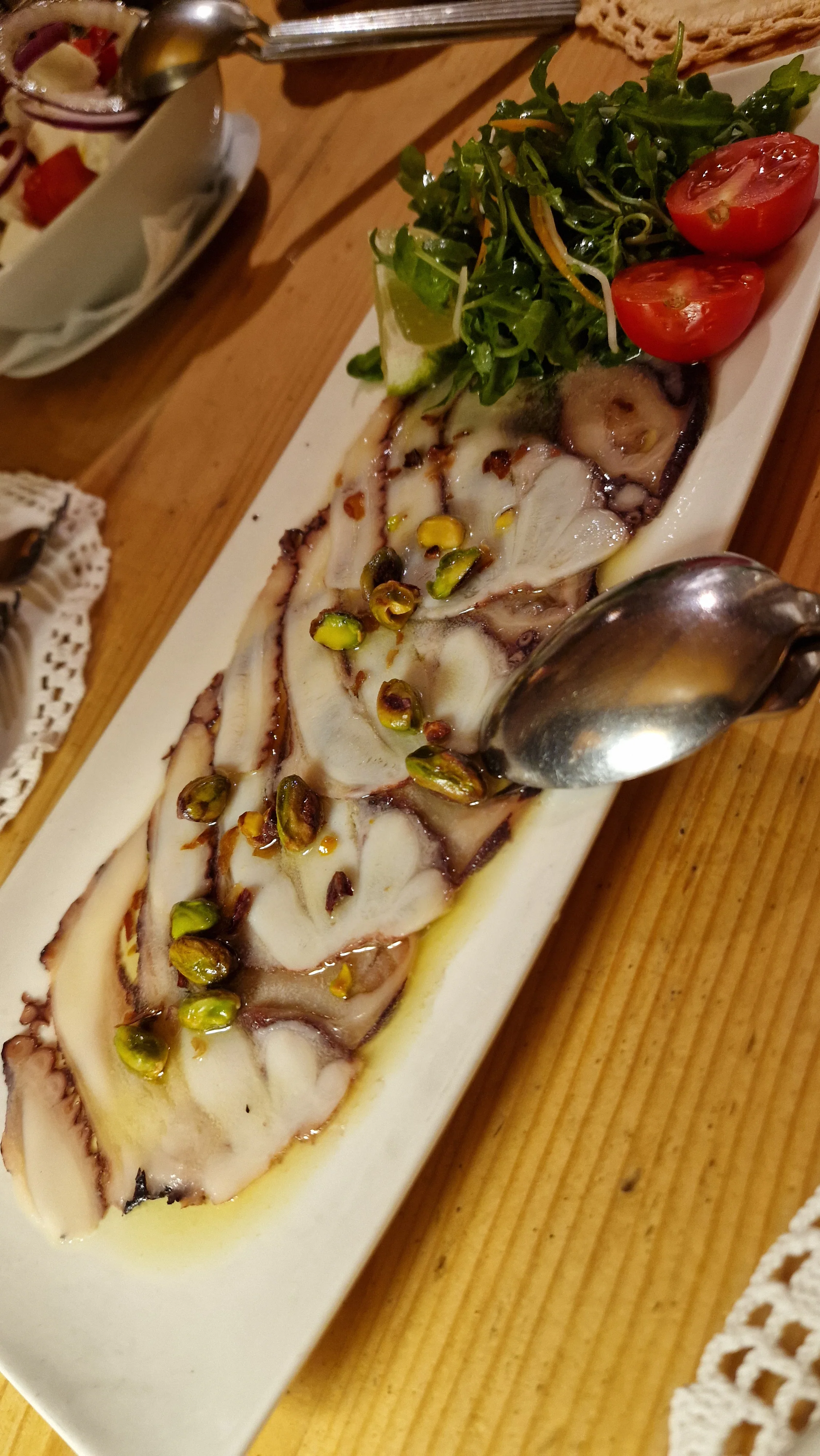
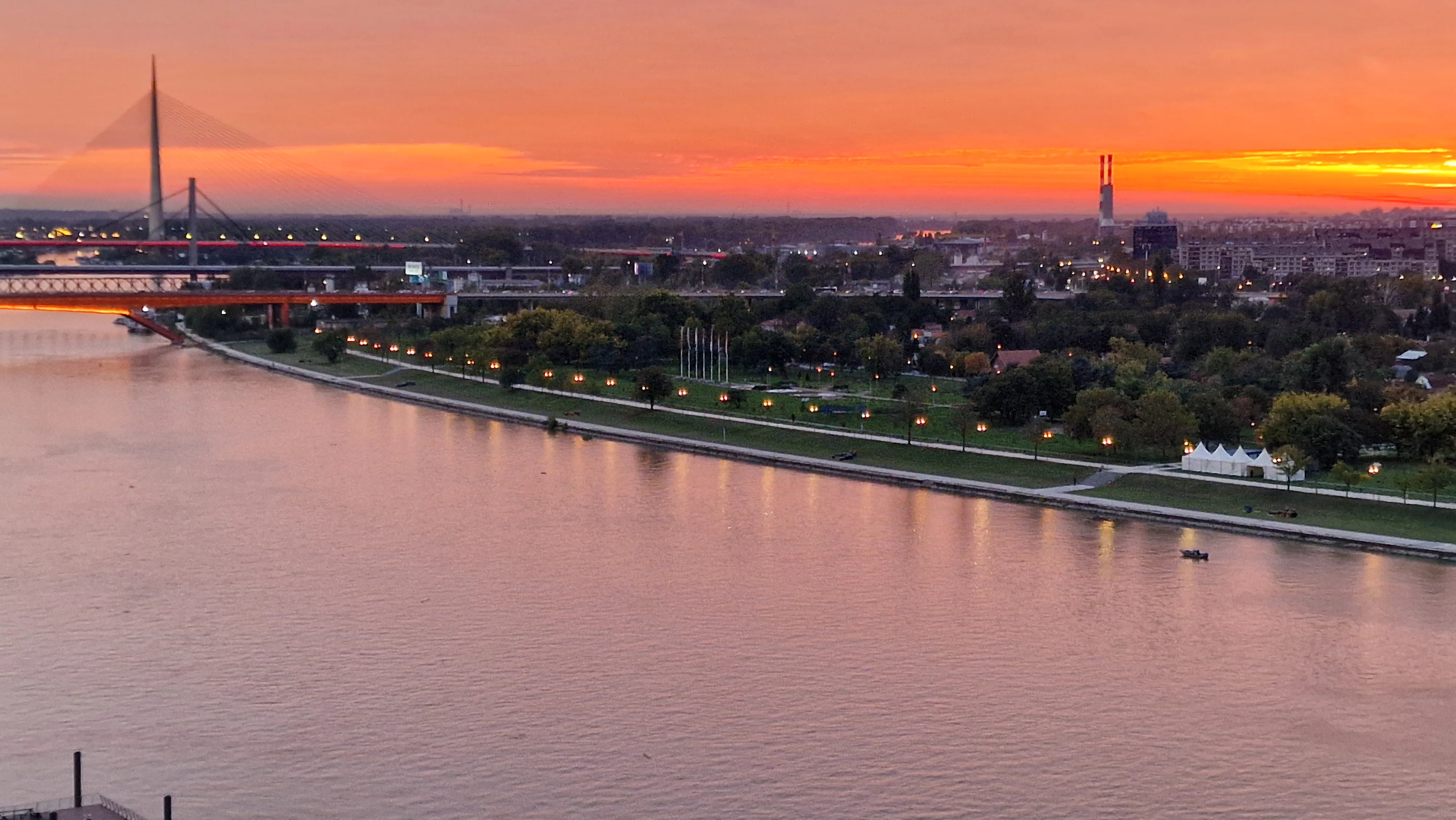
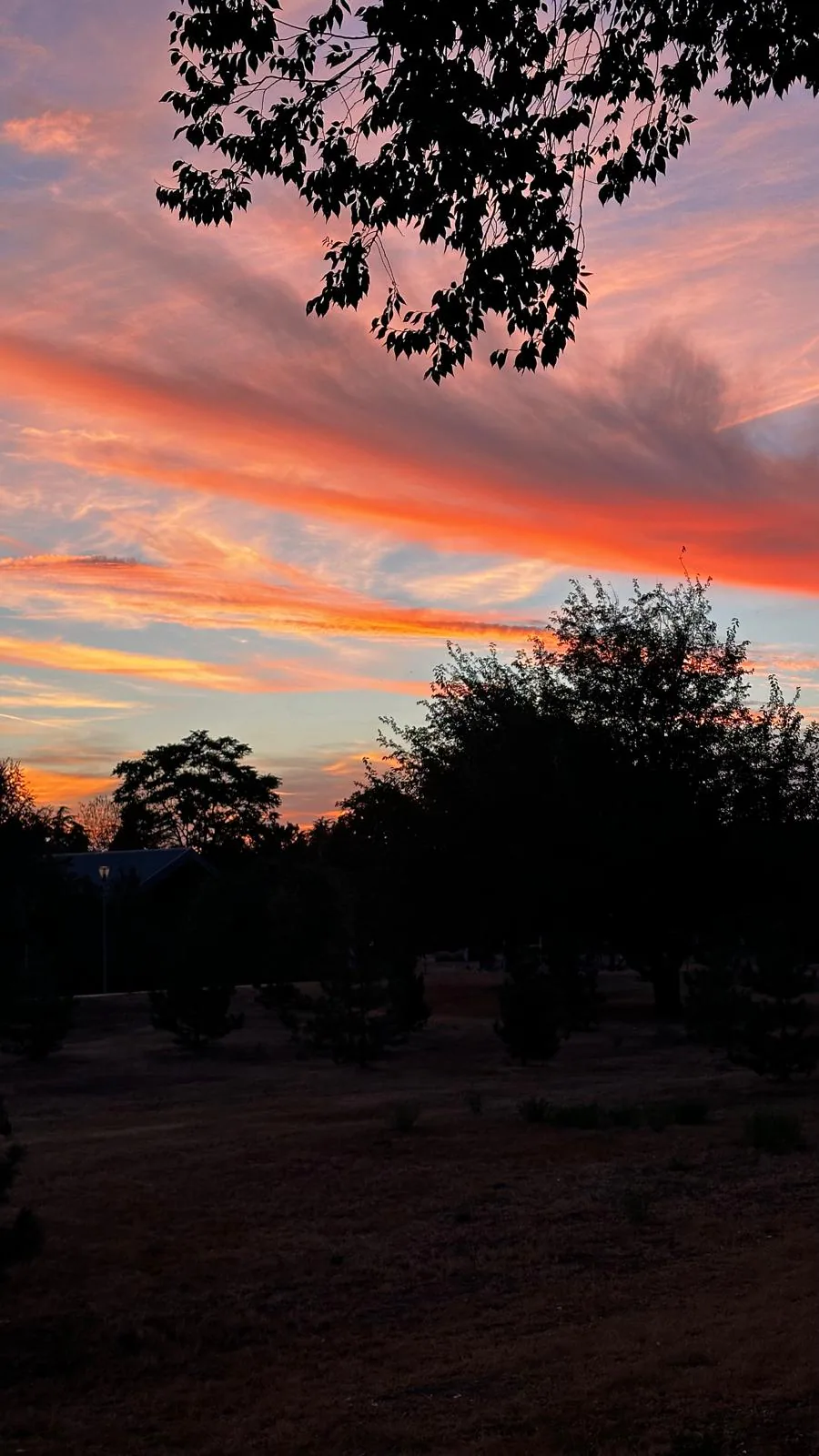
Stari Žabar sits in Zemun — technically Belgrade, but Zemun has always felt like its own place: the old Habsburg quarter on the right bank of the Danube, with a different tempo, a different street plan, and a string of restaurants that make you forget you are in a landlocked capital. It is a splav — the word means simply “raft” in Serbian, but in Belgrade it has acquired a meaning all its own: a floating restaurant or bar moored to the riverbank, part of a culture that lines both the Danube and the Sava with several hundred such venues and is found nowhere else in the world quite like this. The service here was impeccable. Before moving to Belgrade, I had spent five months in Phuket — a place where you buy seafood straight off the boat at the morning market — which makes the landlocked reality of Serbia feel particularly acute. Good seafood here is the exception, not the rule. Which is why the tiger prawns at Stari Žabar came as a genuine surprise: grilled, with lime and greens, alongside octopus and fish, and none of it had any business being that good in a landlocked capital. It was also my second encounter with Joško Gravner's Ribolla — the first had happened in Singapore three years earlier, and it had left a strong enough impression that when I saw the old friend on the wine list, I ordered a bottle without checking the price — and then ordered a second one to take home, for which I chalked up a whopping €500 bill for a dinner for two. Never regretted it for a second.
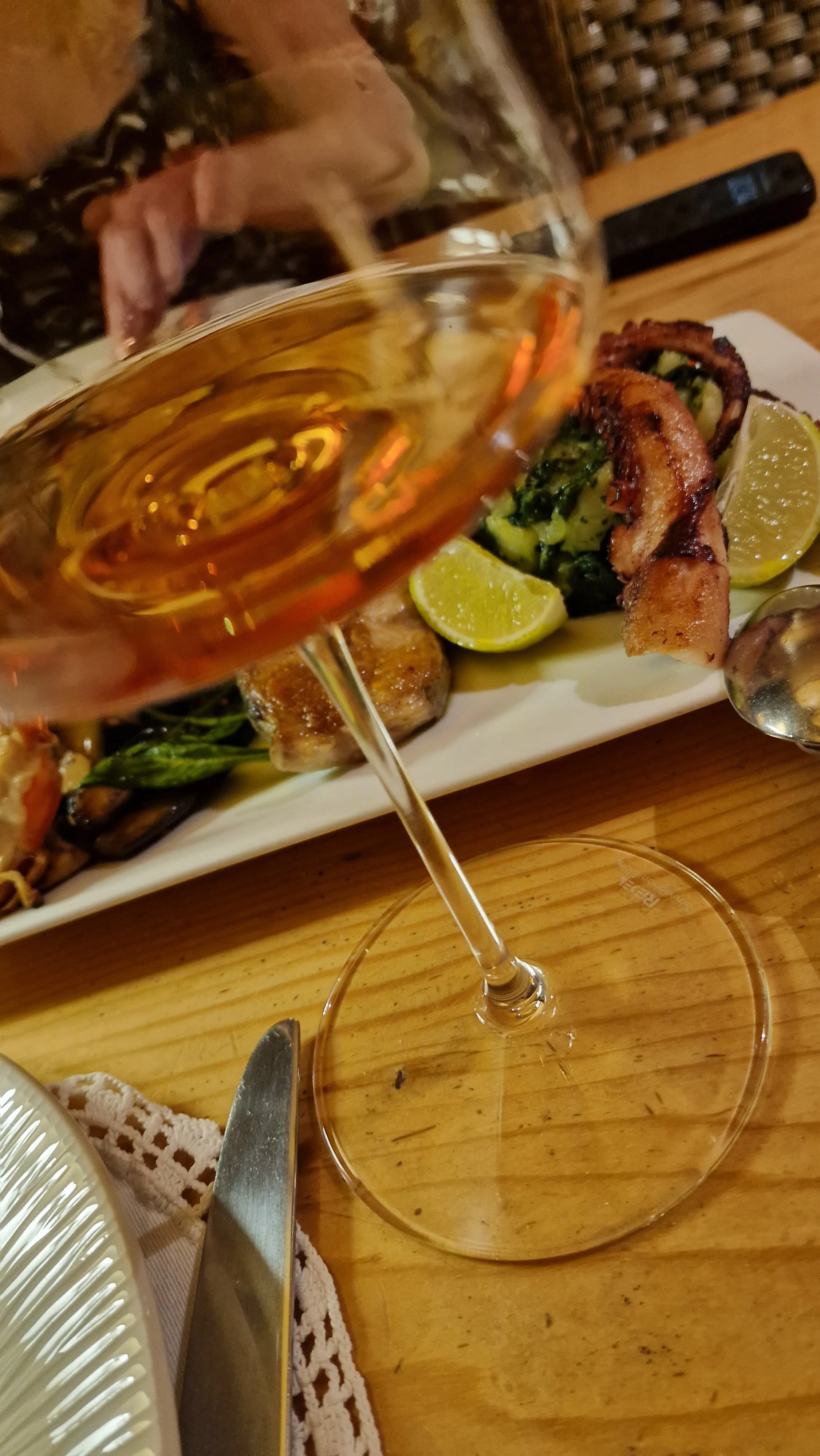
The wine in the glass was amber — deep, burnished, the colour of old honey held up to a lamp. Ribolla Gialla is a grape indigenous to the eastern edge of Italy and the western edge of Slovenia, and in most hands it makes a crisp, fresh white. In Gravner's hands it becomes something else entirely: six months of skin contact in buried qvevri — the clay amphorae of Georgian winemaking tradition — followed by roughly six years in large old botti of Slavonian oak, then bottled without fining or filtration. The result is a structured, phenolic, oxidatively complex amber that drinks more like a serious red than anything the word “white” implies.
Joško Gravner did not start this way. In the 1980s and early 1990s he was doing what serious Friuli producers were doing — investing in modern equipment, stainless steel, technical precision, clean fruit. The turn came in 1996, when hail destroyed most of the harvest and he was left with only a small quantity of Ribolla Gialla. Rather than discard it, he experimented with skin contact — fermenting the white grape like a red, with skins, pulp and pips left in contact with the juice. Ribolla's particularly thick skin made it ideal for the process. The result was his first amber wine. Skin contact on white grapes had in fact been practised in the region for centuries before being largely abandoned in the 1950s, when the market turned toward cleaner, technology-driven whites. Gravner was not inventing something new, he was recovering something that had been forgotten — and taking it further than anyone before him. In 2000 he travelled to Georgia — after waiting two years for a visa, eventually entering the country with an armed escort.
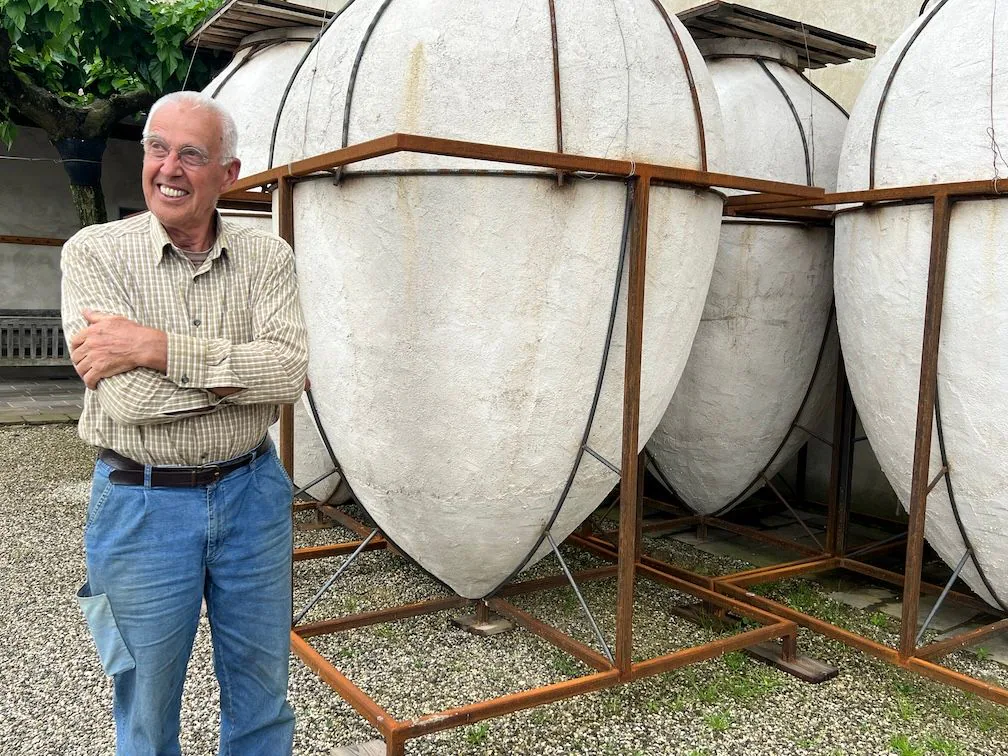 Joško Gravner and his qvevri, May 2024. Credits: photo by Peter Dean for The Buyer, from the article “I am curious orange” — inside the magical world of Joško Gravner, published on August 9, 2024.
Georgia, where wine had been made in qvevri since 6,000 BC, had seen its ancient winemaking tradition pushed underground by Soviet industrialisation from 1921 — commercial qvevri production had largely ceased, though the practice survived in home winemaking throughout the Soviet era. Gravner placed his first order for eleven qvevri, which then made a journey of 3,000 km by sea to Oslavia — nine arrived broken. He ordered more. Since 2001, all his white wines have been fermented in qvevri, and by 2012 he had uprooted the last of his international varieties — Chardonnay, Sauvignon Blanc, the rest — leaving only indigenous Ribolla Gialla and Pignolo. Gambero Rosso — Italy's most influential wine and food publication — published a piece in December 1999 titled “In caduta libera” — “In free fall” — declaring that his new wines were a disaster: faulty, oxidised, undrinkable. The coup de grâce was that the magazine had not been sent any samples and had not tasted them.1 More than half of Gravner's customers returned their shipments without opening a bottle. The wine world, as it turned out, was wrong. Within a decade, his amber wines had become reference points for an entirely new category — skin-contact whites went from regional curiosity to global phenomenon, and Gravner's name became inseparable from that story. Today his Ribolla is one of the most sought-after and critically acclaimed white wines in Italy. At 72, he continues to experiment, refine, and push further, with the same uncompromising conviction that once cost him half his customer base.
Joško Gravner and his qvevri, May 2024. Credits: photo by Peter Dean for The Buyer, from the article “I am curious orange” — inside the magical world of Joško Gravner, published on August 9, 2024.
Georgia, where wine had been made in qvevri since 6,000 BC, had seen its ancient winemaking tradition pushed underground by Soviet industrialisation from 1921 — commercial qvevri production had largely ceased, though the practice survived in home winemaking throughout the Soviet era. Gravner placed his first order for eleven qvevri, which then made a journey of 3,000 km by sea to Oslavia — nine arrived broken. He ordered more. Since 2001, all his white wines have been fermented in qvevri, and by 2012 he had uprooted the last of his international varieties — Chardonnay, Sauvignon Blanc, the rest — leaving only indigenous Ribolla Gialla and Pignolo. Gambero Rosso — Italy's most influential wine and food publication — published a piece in December 1999 titled “In caduta libera” — “In free fall” — declaring that his new wines were a disaster: faulty, oxidised, undrinkable. The coup de grâce was that the magazine had not been sent any samples and had not tasted them.1 More than half of Gravner's customers returned their shipments without opening a bottle. The wine world, as it turned out, was wrong. Within a decade, his amber wines had become reference points for an entirely new category — skin-contact whites went from regional curiosity to global phenomenon, and Gravner's name became inseparable from that story. Today his Ribolla is one of the most sought-after and critically acclaimed white wines in Italy. At 72, he continues to experiment, refine, and push further, with the same uncompromising conviction that once cost him half his customer base.
The broader region — Friuli-Venezia Giulia — is best known internationally for something entirely different: this is the same macro-region whose provinces also fall inside the Prosecco DOC zone. The distance in style between a fresh, lightly sparkling Prosecco and a Gravner Ribolla aged eight years before release is hard to overstate, but they share the same northeastern Italian geography, the same Adriatic and Alpine climatic crosswinds, the same complicated layering of Italian and Slovenian cultural memory. Gravner's winery existed in that overlap long before orange wine became a category with a name.
The pairing at Stari Žabar made complete sense. Tiger prawns have that sweet, iodine-rich umami that amber wine — with its phenolic grip and saline undercurrent — meets exactly where it needs to. The grilled fish alongside it pulled in the same direction. It was the kind of thing that works in a riverside splav in Zemun when you are landlocked, craving the sea, and someone puts the right bottle on the table.
1 Gambero Rosso, December 1999, “In caduta libera.” Cited in Luciano Pignataro, “Josko Gravner e un'antica stroncatura sul Gambero Rosso”, lucianopignataro.it, 2024.
Pairs well with