There is a first time for everything, and for anyone with interest in wine, sooner or later that includes a glass of wine made somewhere not commonly associated with winemaking. India is one of those places. If I'm asked whether I take Indian wine seriously, I'd say that some things in life are better taken simply as phenomena, without first checking whether they fit the picture of the world one already has. Mine came on the first evening of a business trip to Chennai, at a resort on the Coromandel Coast about 40 kilometres south of the city, in a village the British wrote as Covelong and Tamil speakers call Kovalam.
The ground under the resort has a stranger history than its brochure suggests. In the 1720s the Ostend Company, a trading venture chartered in 1722 by the Habsburg emperor Charles VI for the merchants of the Austrian Netherlands, roughly today's Belgium, built a fort here on land granted by Saadat Ali, the Nawab of the Carnatic: a nawab was a provincial governor under the Mughal emperors who by then ruled his province as a hereditary prince, and the Carnatic was his territory, the plain of south-east India between the Eastern Ghats and the sea. London and Amsterdam regarded the company as a trespass on their Asian trade and leaned on Vienna until it was suspended in 1727 and wound up in 1731. The French took the fort in 1746, the British took it from them in 1752 and destroyed it, and in 1974 a hotel went up on what was left of the ramparts. At Bay View, the resort's seafood restaurant a few steps from the Bay of Bengal, my colleagues and our Indian business partners sat down to dinner on the night before a conference.
Around the table the drinks divided two ways, whisky or beer, and nobody found that remarkable - it is the Indian norm. Spirits and beer make up something like 98% of the alcohol the country drinks, whisky alone accounts for more than half of all servings, and much of that whisky is distilled from sugarcane molasses and would not be allowed to call itself whisky in the European Union. Wine, by an often-quoted estimate, comes to about 9 millilitres a head a year. This is not because the subcontinent never met the vine. Grapes most likely arrived from Persia in deep antiquity. Chanakya, the adviser to Chandragupta Maurya in the fourth century BC, recorded a grape wine called madhu at court while condemning drink in general, and two Mughal emperors, of the Muslim dynasty from Central Asia that ruled most of the subcontinent from 1526 until the British displaced it, Babur and Jahangir, were fond of wine in spite of Islamic law. The Portuguese brought port-style wine to Goa in the 16th century, and under the British vineyards spread around Baramati, in Kashmir and near Surat, well enough for Indian wines to be shown with some success at the Calcutta International Exhibition of 1883. Phylloxera, the American root louse that had already ruined much of Europe, finished most of them before the century was out. Independence finished the idea. Article 47 of the 1950 Constitution, one of the directive principles of state policy, commits the state to "endeavour to bring about prohibition of the consumption except for medicinal purposes of intoxicating drinks". In the 1950s state after state went dry, vineyards were uprooted or turned over to table grapes and raisins, and what India drank instead came from palm sap as toddy, distilled into arrack, from cashew apples in Goa as feni, and from mahua flowers in the forests of central India. Wine returned in the 1980s, and in earnest only in 1999 with Sula, founded by Rajeev Samant, a Stanford-educated engineer who came home from Silicon Valley, and now the country's largest winery. It was planted at Nashik, a Hindu pilgrimage city on the Godavari about 170 kilometres north-east of Mumbai, until then known for table grapes and now called the wine capital of India.
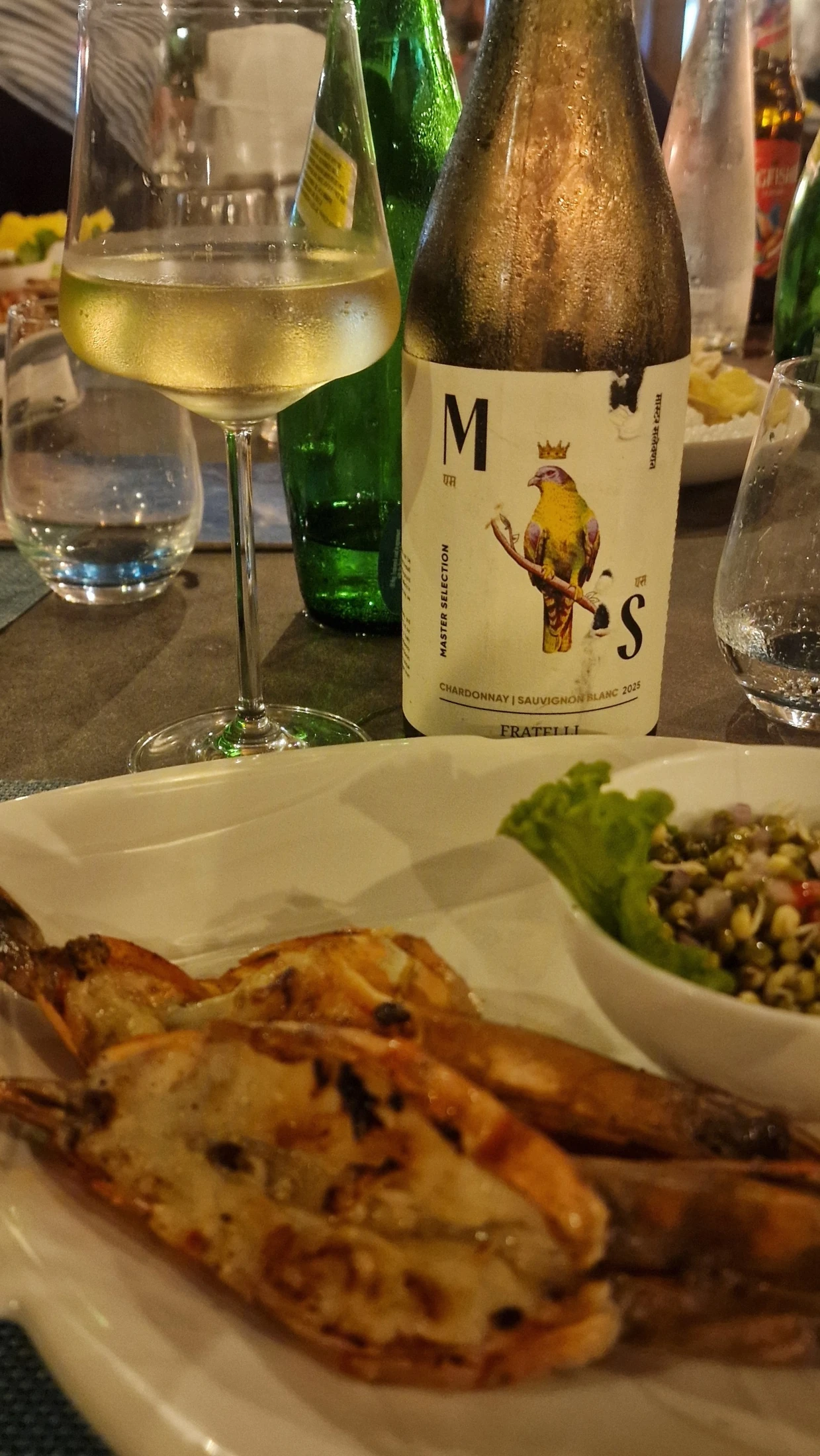
The back label of my bottle carried a lesson in how the system still works: "For sale in Tamilnadu state only." Under the Indian constitution alcohol is a state matter.. Tamil Nadu still regulates drink under the Tamil Nadu Prohibition Act of 1937, under which government first introduced prohibition in the region, and since an amendment in 2003 the only legal retail seller in the state has been the Tamil Nadu State Marketing Corporation. So a wine grown and bottled in Maharashtra, roughly a thousand kilometres away by road, could be sold legally in Tamil Nadu and nowhere else, including the state that made it. For dinner, between whisky and beer I will choose wine in any case. Here the choice had two further arguments: Indian wine was the exotic option at that table, and I simply liked the idea of writing about it here.
The producer, Fratelli, takes its name from the Italian for brothers, and there were three pairs of them. By the usual account the idea came up over wine on a holiday in Italy in 2006, when Kapil Sekhri of New Delhi and Alessio and Andrea Secci from Italy agreed that India had no good wine and decided to make some. Kapil's brother Gaurav joined, and so did Ranjitsinh and Arjunsinh Mohite-Patil, which settled where the vineyards would go. Akluj, in Solapur district, is Mohite-Patil country. Their grandfather Shankarrao Mohite-Patil founded the cooperative sugar factory at Akluj and a political dynasty with it; his son Vijaysinh became Deputy Chief Minister of Maharashtra. In a state where sugar cooperatives are the backbone of rural politics, a cane family planted European vines, from 2008, on about 97 hectares 170 kilometres south of Pune, well away from Nashik, where almost all Indian wine is made. To make the wine they brought in Piero Masi, a Tuscan who had worked for years at Isole e Olena, a leading Chianti Classico estate, with a brief Gaurav Sekhri later summed up as "wine that we are happy to drink ourselves". The Master Selection range began, as the winery tells it, with a film about the Judgement of Paris watched in Akluj. The founders wrote to Steven Spurrier, the English wine merchant who in 1976 organised the blind tasting in Paris at which California beat Bordeaux and Burgundy, and he and Masi put together a reserve range of a white, a rosé and a red, first released in 2015. M/S stands for Master Selection and, less officially, for Masi and Spurrier. The cost came quickly. Kapil Sekhri died in October 2020, Spurrier in March 2021 and Masi at the end of April 2022. When the range was relaunched with the 2023 vintage, its label carried a Hariyal, the yellow-footed green pigeon that is Maharashtra's state bird and which, as the label story has it, never sets foot on the ground. The enologist is now Giovanni Masi, Piero's son.
The terroir starts with latitude. Akluj lies at about 18° North, closer to the equator than any classic vineyard, so the vine never gets the winter that would send it into dormancy. The grower supplies the seasons with secateurs instead. A foundation pruning in April, at the end of the hot season, grows the canes that will carry next year's fruit; a fruit pruning in October, after the monsoon, sets the crop, which ripens through the dry, cooler months and is picked from about January. The calendar exists to keep ripening clear of the rains. The estate sits on the Deccan Plateau above the right bank of the Nira River, with the white-wine vineyards at almost 550 metres, high enough for cool nights in a subtropical climate. The importer describes the soils as poor and free of clay, and the back label of this bottle names the source as the rocky soils of plot G at the Garwad vineyard (the producer's own pages cite Garwad and a second site, Motewadi). Clay-free soil drains fast and holds back vigour, which matters twice in a humid climate: less leaf means more air around the bunches and less mildew. Yields are reported at about half the Indian average, so the fruit can ripen before the weather turns.
The 2025 on the label needs translating. An Indian vintage starts with the fruit pruning of October 2024 and ends with a harvest early in 2025, and Fratelli has published nothing about what happened in between. The national weather record fills part of the gap. In mid-October 2024, just as the vines were being pruned, three days of heavy rain hit Nashik, 300 kilometres to the north, and damaged crops on 45,000 hectares; whether it reached Akluj, nobody reported. Then the sky shut. Central India got about a tenth of its normal winter rain in January and February 2025, and February was the hottest India had recorded since 1901. For a tropical grower that is half good news. No rain means no mildew. Heat in the last weeks means acidity drains out of the grapes faster than sugar builds up, and the only defence is to pick early. The bottle suggests someone did. A sticker hides the first digit of the alcohol, but the label also promises 7.4 standard drinks in 750 millilitres, and at 10 grams of alcohol per drink that comes to 12.5%: modest for the hottest February on record.
The élevage did the rest by doing as little as possible. For the 2023, the importer describes stainless steel, a cool fermentation, no oak and no malolactic fermentation, the conversion of sharp malic acid into softer lactic acid that most Chardonnay goes through. In Burgundy that softening is welcome. In Solapur, where the grapes arrive with little acidity to spare, it is a luxury, so the cellar skips it. (The producer's own blog mentions oak, and the 2025 details are unpublished.) What remains is a division of labour: Chardonnay for body, pear and melon, Sauvignon Blanc for the lift that keeps the finish from going soft.
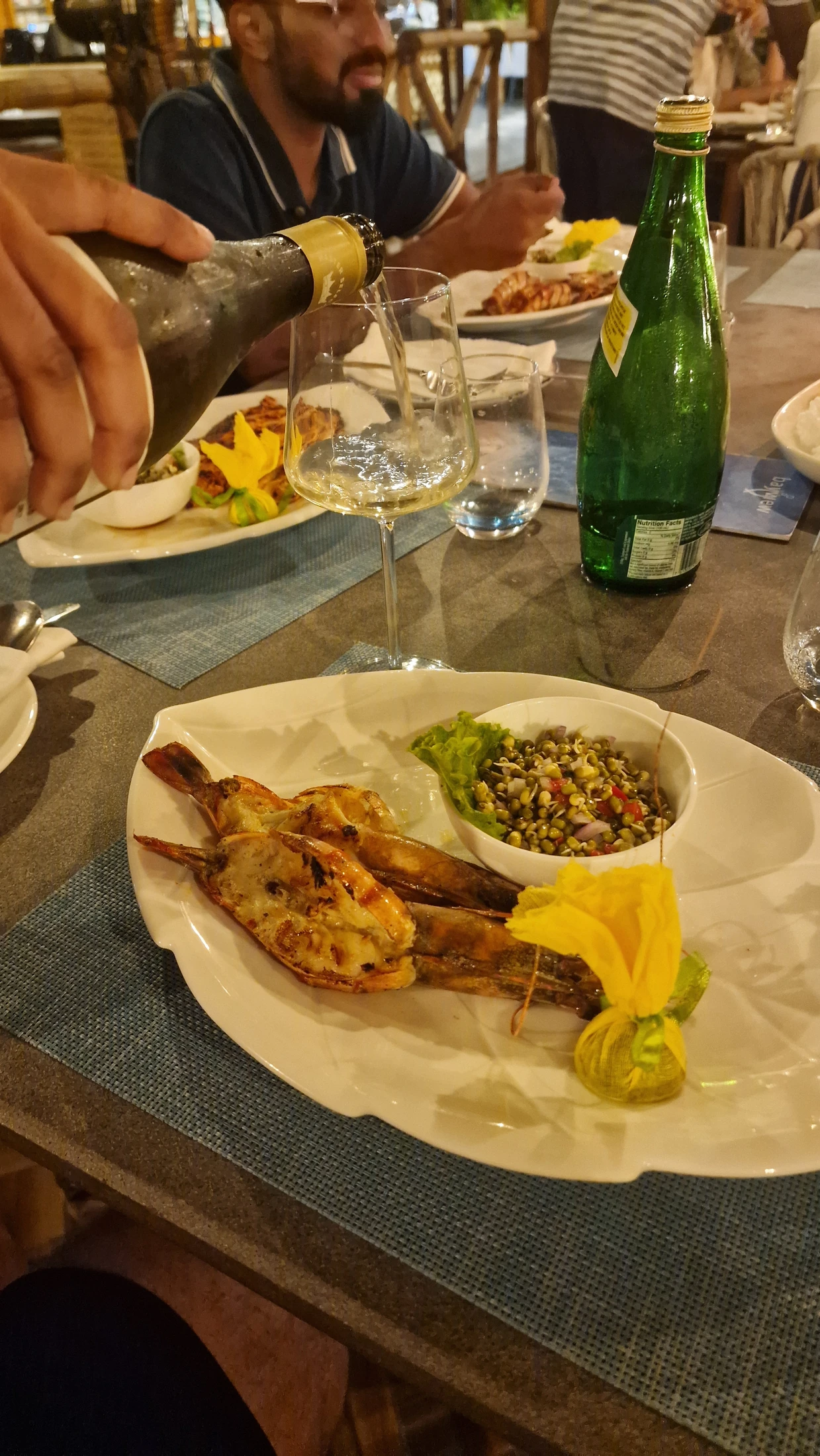
The food was tiger prawns from the grill and a bowl of something I did not recognise. The table told me it was green gram, the name explained nothing, so I looked it up on my phone: moong, the mung bean, sprouted and dressed with raw onion, tomato and lime. White wine with prawns is a safe argument. Grilled prawn flesh is sweet, the char adds bitterness and the marinade some spice, and a crisp, unoaked white at 12.5% meets the sweetness with fruit, cuts the char with acidity and does not inflame the chilli the way a stronger wine would. The green gram is another question. but given the circumstances, this wasn’t exactly the place to look for a proper pairing.
Whisky on one side, beer on the other, and in the middle a Maharashtra white that could only be sold in Tamil Nadu. Every first time has to start somewhere.
Pairs well with


