

I found the shop by accident. Walking home from my barber’s in Vračar one day, I passed a small turquoise frontage on Mileševska that sold nothing but pasta fresca, or fresh pasta, a thing I had not known existed in this city, on a street I had walked down a hundred times without looking up. The information sat in my head for a couple of weeks without producing any action. Then came one of those July Saturdays when what you want is a market: produce you can pick up, turn over in your hands and inspect before deciding whether to buy it. Kalenić is only a few minutes’ walk from the shop, which settled the whole afternoon.
Kalenić is a man, not a neighbourhood. Vlajko Kalenić (1851–1908) was a shoemaker from Mali Mokri Lug, then a village outside Belgrade, who later made his fortune in land and produce. On 30 June 1907, knowing that he was dying, he signed a will leaving everything he owned to Serbia for educational purposes, at the time one of the largest private benefactions the University of Belgrade had received. What the city eventually built on his land was not a school. The market opened on 1 November 1926 on the site of his old threshing floor. It began as five hundred square metres of stalls at what was then the edge of town, one of four markets the city placed around its outskirts after finally closing the overcrowded Velika pijaca in the centre. German bombs hit it in April 1941. During the occupation, parts of the market ground were dug up and turned into vegetable plots by people who could no longer afford to buy the food sold there. It has been the best produce market in Belgrade more or less ever since.
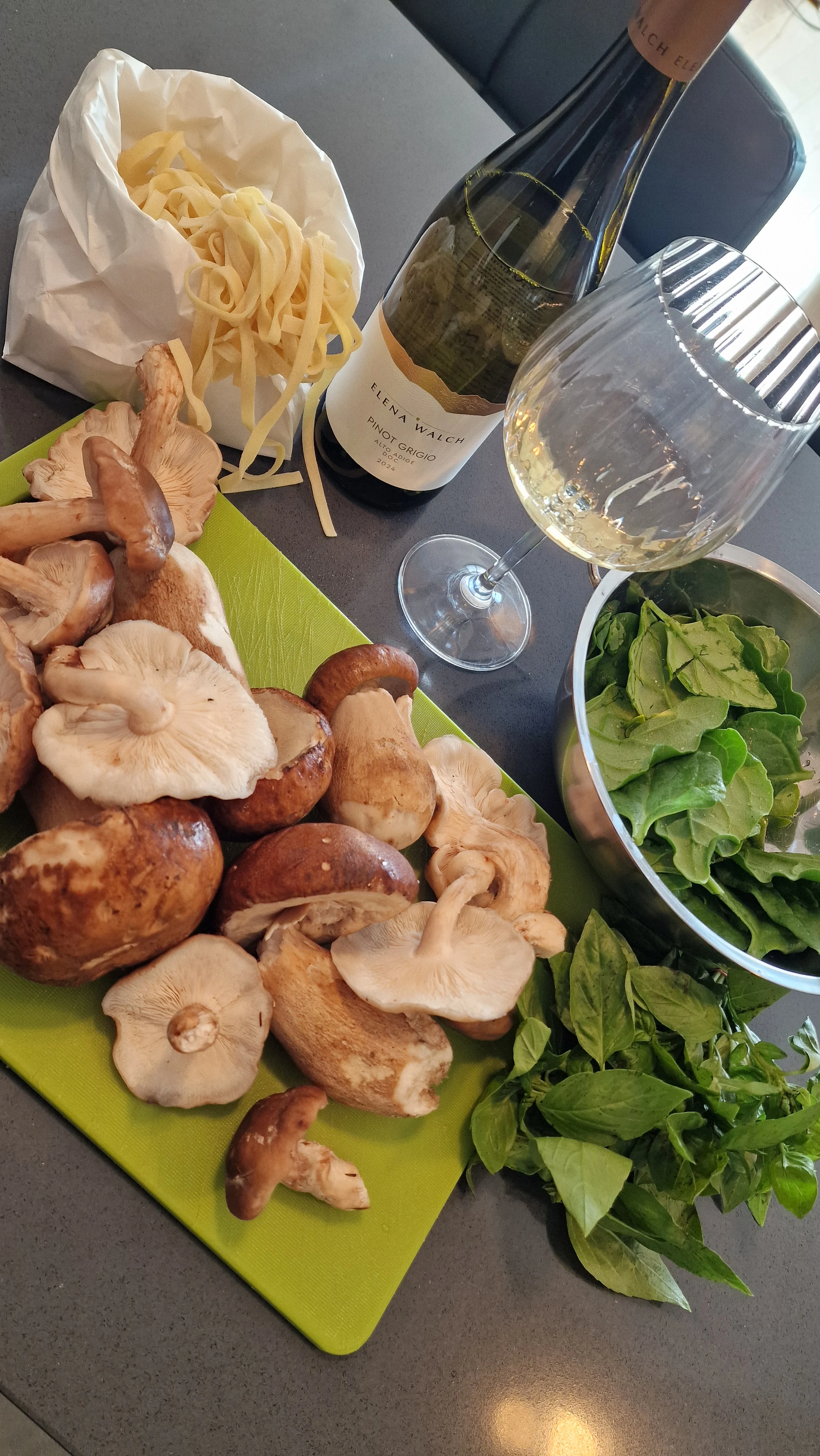
That Saturday, it had vrganji. The Serbian name covers Boletus edulis, the mushroom Italians call porcini, from porco, ‘piglet’, apparently because of its thick, squat stem. In English, it is usually called a cep or penny bun. It is also the one prestige mushroom nobody has really managed to farm. A porcino does not simply grow in soil on its own. The fungus lives in partnership with the roots of certain trees. It helps the tree absorb minerals and water, and the tree feeds it sugars in return. Remove the tree and the mushroom will not fruit. That is why porcini cannot be grown predictably in sheds in the way oyster mushrooms or button mushrooms can, and why their price depends on rain, temperature and the condition of somebody else’s forest. Everything on that stall had been found there and carried out by hand. I bought the mushrooms, took spinach from the next row and walked over to Mileševska for the tagliatelle. On the way in, I discovered that the wine problem had solved itself. Volver is at number 3. Le Nonne is at number 5. Pasta and wine two doors apart is either urban planning or providence.
Pasta fresca needs explaining, because ‘fresh’ may be the most abused word in the food business. It is attached to anything that has not yet visibly deteriorated, but fresh pasta is not simply dried pasta made more recently. It is a different product, designed to behave differently. Italian law treats the two as separate categories. Dried pasta is made from durum wheat semolina and water and may contain no more than 12.5% moisture. Fresh pasta contains roughly 30%. Dried pasta has had almost all its moisture removed. During drying, its network of starch and gluten becomes dense and hard. When you put it into boiling water, the water must first work its way back inside before the pasta can soften. That is why dried pasta takes around 10 minutes to cook, and why it can retain a genuinely firm centre. The familiar al dente bite is possible because the outside cooks before the water has completely reached the middle. Fresh pasta begins with much of that water already inside it. The heat reaches the starch almost immediately, so it cooks in 2-3 minutes. Its surface is softer and releases more starch directly into the sauce, which helps the sauce cling to the pasta and gives it the texture people describe as creamy. It is not better pasta; it is a different animal. Dried spaghetti is built to keep its shape and resist the teeth. Fresh tagliatelle is built to soften quickly, take on sauce and become part of it. Bojana Damjanović, who founded Le Nonne, imports her semolina from one small mill in Puglia. She has said that the hardest part of building the business was not buying machinery or finding money. It was explaining the distinction between fresh and dried pasta, first to customers and then to restaurateurs who assumed that one was merely a more expensive version of the other. Her brand started in 2018 and now produces four tonnes a month. Apparently, my great discovery had been operating 300 metres from my barber for years.
Next door, the logic ran the other way: I knew what I wanted before I went in. Elena Walch trained as an architect and married into the Walch family of Tramin in the 1980s, joining a wine estate that was already old in a valley where old is the baseline. At the time, Alto Adige wine was still largely organised around co-operatives, high volumes and Vernatsch, the dependable local red grape that filled tankers heading north into Austria. Elena Walch began pulling it out and planting international varieties instead. More importantly, she started bottling wines from individual vineyards under their own names, including Castel Ringberg at Caldaro and Kastelaz at Tramin. Naming a vineyard on the label is a commitment. Once you tell the buyer exactly where a wine came from, you can no longer hide a poor year by blending it into wine from somewhere more successful. The vineyard gets the credit in a good vintage and takes the blame in a bad one. Her daughters, Julia and Karoline, run the estate now.
This particular bottle is not one of the single-vineyard wines. It belongs to the Selezione range and is drawn from vineyards spread between 250 and 900 metres above sea level, on slopes facing south-east and south-west. The soils are based on limestone but also contain clay, sand and porphyry, the hard volcanic rock found along the valley’s eastern side. Those details sound geological, but in the glass their effect is less mysterious than wine language often makes it seem. Different soils hold water and heat differently, while the wide range of elevations means that some grapes ripen in warmer sites and others in cooler ones. The altitude range tells most of the story. Warm air moves north through the Adige valley from Lake Garda during the day. After sunset, colder air descends from the Dolomites. The grapes therefore receive enough warmth to ripen properly, but the nights are cool enough to slow everything down and preserve acidity. In practical terms, the fruit can become ripe without becoming heavy. Pinot Grigio is a colour mutation of Pinot Noir. Genetically, it belongs to the same family, but instead of black skins it develops skins that range from grey and copper to dusty pink. On the flat vineyards of Veneto, it is often planted for volume and picked early. High yields and early harvesting produce a great deal of perfectly serviceable wine with very little aroma, which is how Pinot Grigio acquired its reputation for tasting of almost nothing. On a steep slope, picked by hand at lower yields, it behaves differently. The skins have time to develop the pear, spice and faint white-pepper character that the grape possessed all along.
2024 made the province earn its whites. The mildest winter in decades brought an exceptionally early start to the growing season. The regional consortium dates the beginning of vine growth to around 20 March. A month later, temperatures collapsed and frost spread across the province. The vines had woken too early and were therefore exposed when the cold returned. Cool, cloudy weather followed. Fewer flowers developed into grapes, and the bunches that survived carried fewer berries. Pinot Grigio, together with Lagrein and Gewürztraminer, suffered some of the lowest yields in Alto Adige. Losses started at around 15 per cent and reached as high as 70 per cent in the Isarco Valley. The harvest came late and was repeatedly interrupted by rain. What saved the white wines was the change in September, when temperatures dropped and the grapes were able to finish ripening slowly. Cool conditions near harvest tend to preserve aroma. Heat accelerates ripening but can flatten the more delicate smells in white grapes. The cooler September allowed the fruit to retain definition, which is why producers across the region described the 2024 whites as unusually precise despite the difficult year. The technical sheet gives 1.8 grams of residual sugar, 5.4 grams of acidity and 13 per cent alcohol. The first number means that almost all of the grape sugar was converted into alcohol, leaving the wine firmly dry rather than merely not sweet. The second describes the acidity that gives it tension and keeps it from feeling broad or dull. The alcohol is high enough to provide some weight but not enough to dominate the wine. After pressing, the juice was allowed to settle while cold and still, so that the heavier fragments of skin and pulp could sink naturally to the bottom. The clear juice was then separated and fermented in stainless steel at a controlled 20°C. After fermentation, the wine remained for several months on its fine lees. Lees are simply the spent yeast cells left behind after fermentation. They are no longer alive, but over time their cell walls slowly break down and release compounds that make a wine feel rounder and more substantial in the mouth. The process adds texture without adding the obvious flavours that would come from a wooden barrel. There was no oak and no malolactic fermentation, the secondary process that softens sharp acidity and can give wine a buttery character. The winemaking does one specific job here: it gives enough weight to the middle of the wine to stop the acidity from leaving it feeling thin.
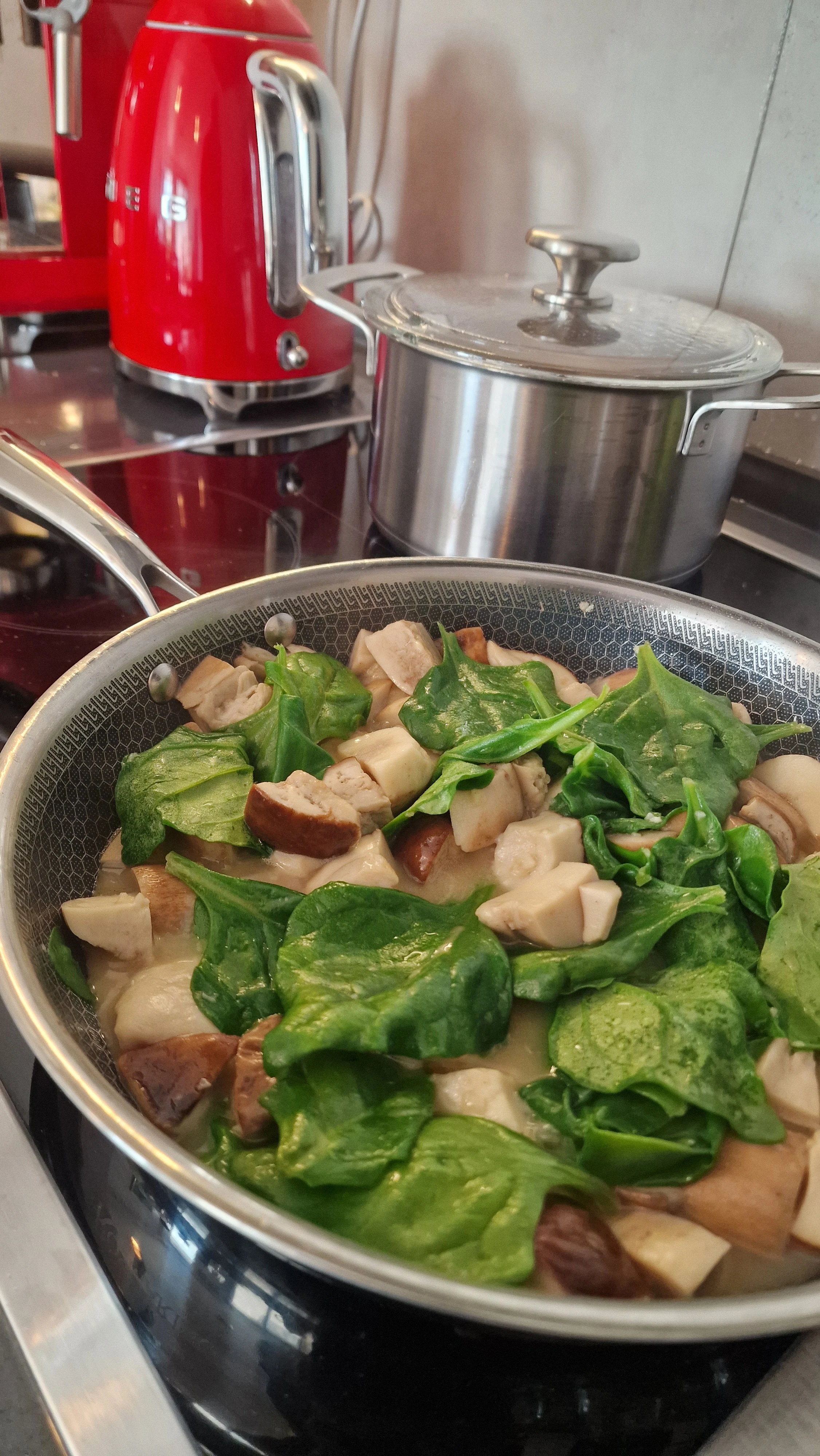
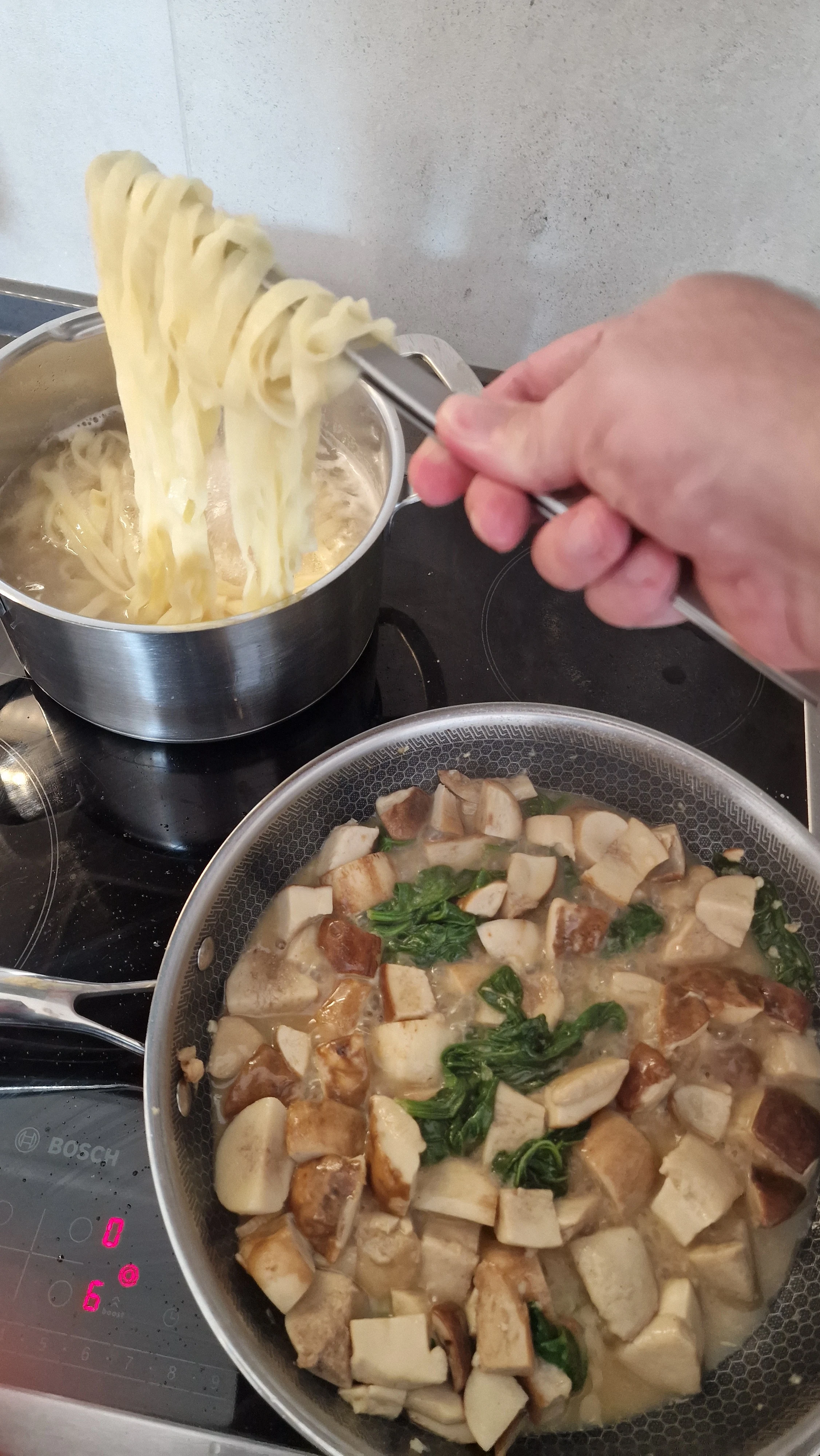
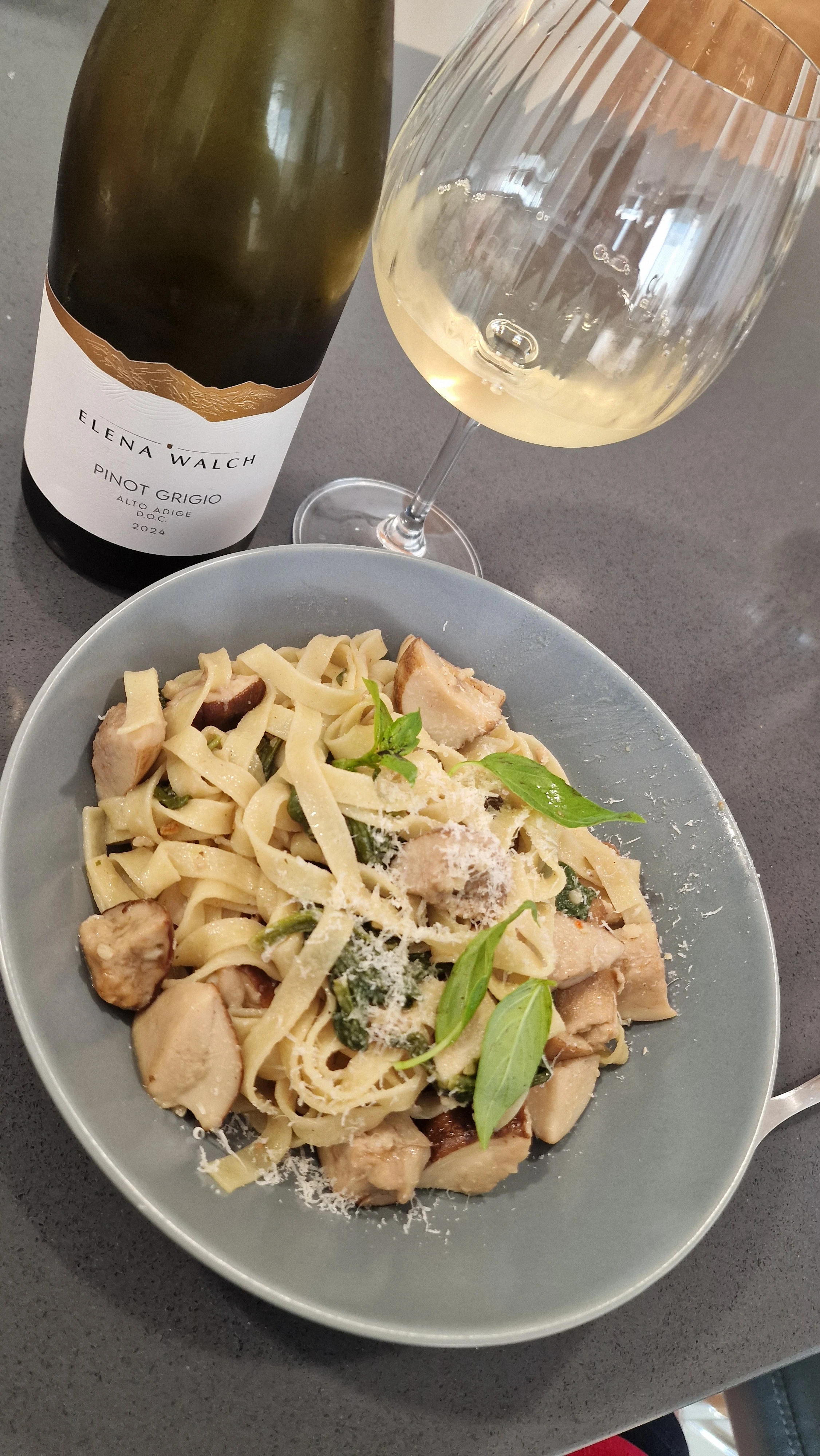
About a 100 millilitres went into the pan once the vrganji had taken colour, and the choice mattered more there than it usually does. When wine is used to deglaze a pan, it lifts the browned material stuck to the surface and carries it back into the sauce. Most of the water and alcohol then evaporate. What remains is a concentrated version of whatever the wine contained in the first place. An oaked white can leave vanilla, toast and the sweet coconut-like compounds that come from wood. A highly aromatic wine can leave the sauce smelling perfumed. An off-dry wine leaves sugar behind, and that sugar can darken and caramelise against the mushrooms. At 1.8 grams of residual sugar and with no oak, this Pinot Grigio left acidity, a slight saline impression and a trace of white pepper. Those are three things a mushroom cream sauce is chronically short of. The mushrooms themselves contribute one type of savoury compound, while the grated cheese contributes another. Chemically, the mushrooms are rich in guanylate and the cheese in glutamate. The names matter less than the effect. The tongue responds much more strongly when the two appear together, so mushroom and aged cheese taste more deeply savoury in combination than either does alone. It is not simply addition - one makes the other louder. The spinach went in at the end. The tagliatelle needed less than 3 minutes. My fiancée and I finished the bottle at the table, which is the other argument for cooking with something you would actually drink.
We went back two weekends later for more of both. Vlajko Kalenić left his fortune for educational purposes and received a vegetable market with his name on it. Standing at that stall, I would say he got what he paid for.
Pairs well with


