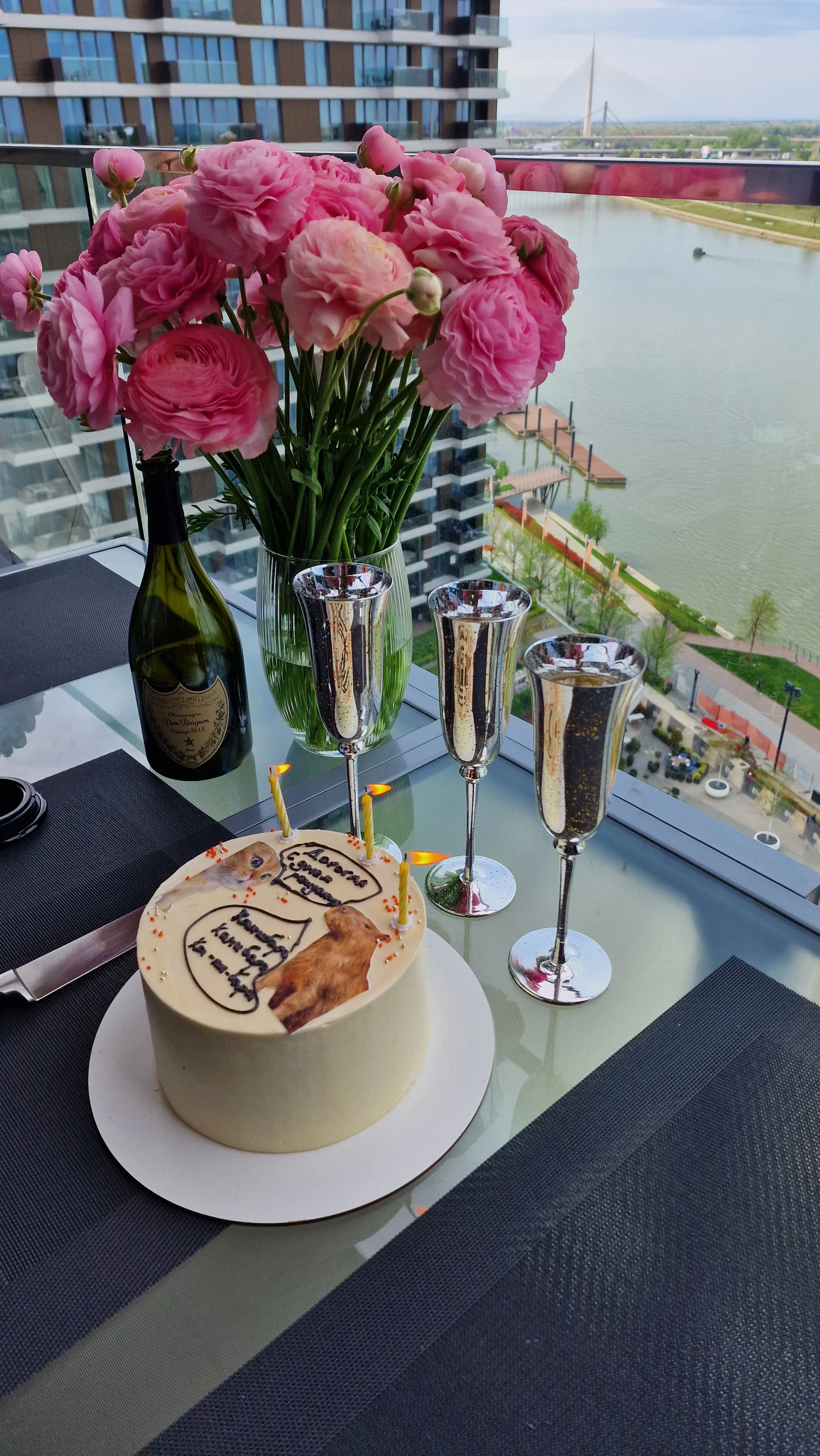
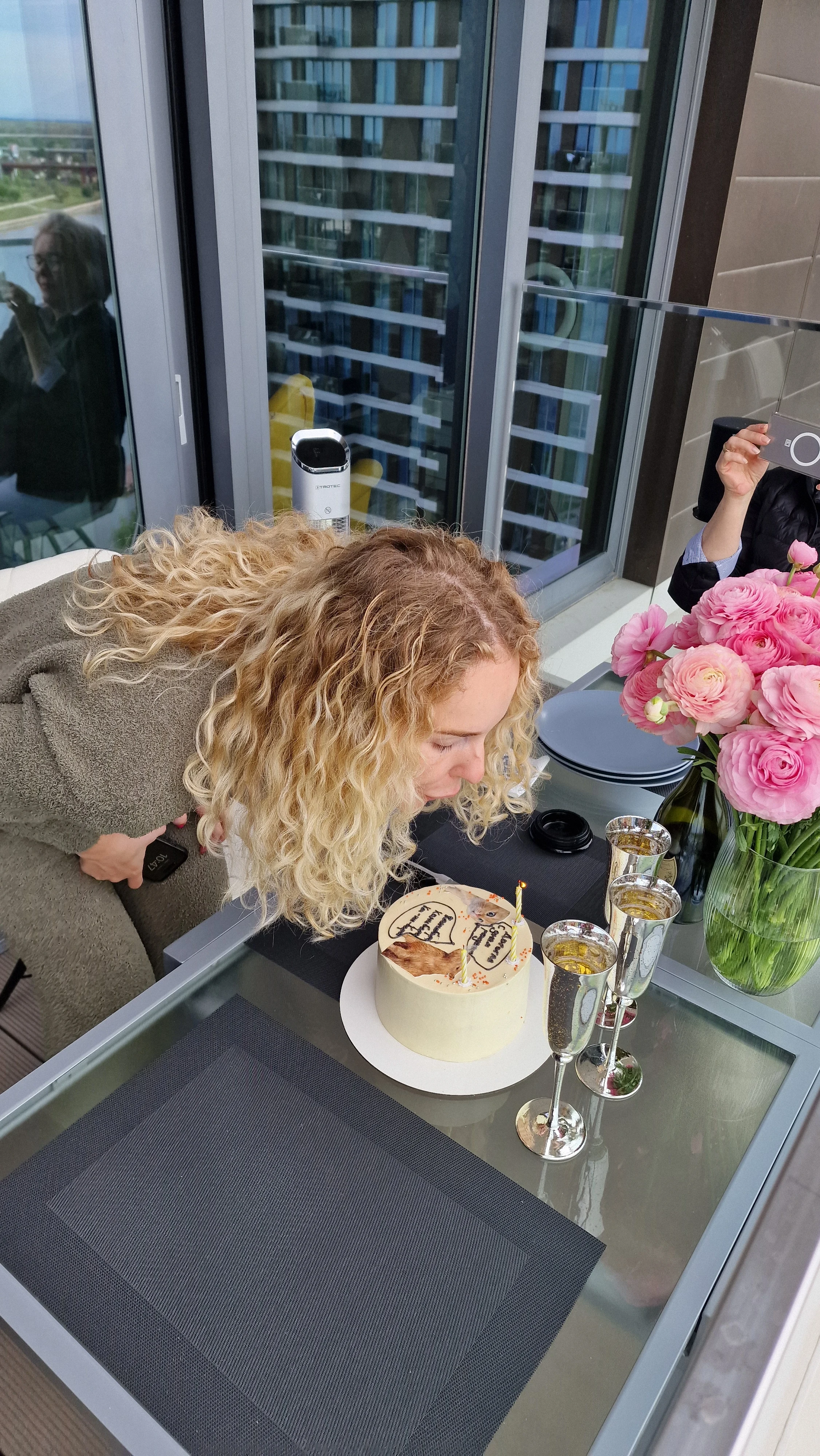
My fiancée’s birthday came with weather worth keeping: April light on the Sava, the Gazela bridge carrying its usual traffic below us, the white pylon of the Ada bridge standing behind it like a sail. We set the table on our own balcony, as tradition dictates — birthday mornings belong to home, the restaurant is kept for the evening. My mother-in-law was visiting from London, which fixed the guest list at three.
The bottle required no deliberation. It had been lying in my wine fridge waiting for exactly this kind of date, and the occasion called for proper champagne: the dark bottle with the shield-shaped label that reads, simply, Champagne Dom Pérignon — Vintage 2013.
The name on that label belongs to a real man who would be baffled by it. Pierre Pérignon — Dom being the honorific for a Benedictine monk — ran the cellars of the Abbey of Hautvillers, on the slopes above Épernay, from 1668 until his death in 1715. Legend credits him with inventing champagne and shouting “Come quickly, I am tasting the stars!” The record shows nearly the opposite. In a cold cellar, fermentation would stall in autumn before finishing; when spring warmed the bottles, the leftover sugar refermented and the trapped carbon dioxide built to five or six atmospheres — roughly triple the pressure in a car tyre — inside glass never designed to hold any. Bottles did not merely leak, they detonated, and each explosion shook its neighbours into going off too, chain-reacting down the racks until a cellar could lose most of a year’s work; cellar hands wore iron masks like fencing gear, and the wine earned the name le vin du diable — the devil’s wine. Pérignon spent much of his career trying to keep bubbles out of wine, not put them in. What he actually pioneered — blending across villages, pressing black grapes into white juice — is the foundation the house still stands on. The line about the stars was written for an advertisement almost two centuries after his death, and the brand is younger still: Moët received the name from the house of Mercier in 1927 — as a wedding present, of all things — and launched the first Dom Pérignon, the 1921 vintage, in 1936, aimed squarely at an America just done with Prohibition.
The bubbles themselves owe less to the abbey than to England. In 1615 James I banned wood-fired glass furnaces — the navy wanted the timber for ships — and English glassmakers switched to coal, which burns hotter and yields thicker, darker, far stronger glass. French bottles, still blown over wood fires, kept bursting under pressure; English ones held. London merchants imported still Champagne wine by the barrel, bottled it in that coal-fired glass, and discovered they liked it when it fizzed. In 1662 — six years before Pérignon even arrived at Hautvillers — the English scientist Christopher Merret described to the Royal Society how adding sugar to a finished wine set off a second fermentation and made it sparkle. While the French spent another century treating bubbles as a fault, the English were paying a premium for them. Champagne, in other words, was popularised by its customers before it was perfected by its makers.
Champagne is, by default, a wine without a birthday. The region sits at the historical northern limit of ripening, where single years were never reliable, so the houses built their style on assemblage across harvests — a base year corrected with older reserve wines until the blend tastes like the house rather than like the weather. That is what non-vintage means, and it is not a compromise; it is the region’s founding insurance policy. A vintage champagne inverts the promise: one declared year, taken as it came, in the years the house judges worth declaring. Dom Pérignon goes further than anyone — it makes nothing else.
What gets declared is Champagne’s usual pair — here 51% Chardonnay to 49% Pinot Noir — drawn from grand cru villages, the top tier of the region’s vineyard classification, across the Montagne de Reims, the Côte des Blancs and the Vallée de la Marne, plus Hautvillers itself, a premier cru kept in the blend for obvious sentimental and less obvious practical reasons. The terroir argument here is chalk: a deep belemnite subsoil — compacted fossil squid, in essence — that drains freely, forces roots down, holds just enough water in a dry year, and gets the credit for the saline cut of the region’s best wines.
And 2013 nearly failed. A cold, wet winter and a rainy spring put the vines two weeks behind schedule, and coulure — flowers aborting at fruit set — cut the crop further. Then the summer swung into one of the hottest and driest in two decades, and a drying east wind before picking kept the fruit clean, so the house could afford to wait. Harvest ran from 28 September to 15 October — a genuinely late picking of a kind Champagne had barely seen since the 1990s, which is why the 2013 has been called the last pre-climate-change vintage. The result was fruit with full ripeness carried on the acidity of a long, cool season: tension, in a year that supplied plenty of its own.
The élevage did the rest: roughly eight years en tirage — in bottle, resting on the lees of its second fermentation — before disgorgement in September 2021 and a low dosage of five grams per litre. Long lees contact is where the brioche and toast come from; the low dosage is what keeps them from turning into dessert. The 2013 was raised under Richard Geoffroy, chef de cave — cellar master — for twenty-eight years, whose definition of the job remains the plainest I know: “We have to take each year for what it is,” he said — so the vintage can tell its own story. He lived by it in the years that scared everyone else — he declared the scorching 2003, the earliest harvest since 1822, a year most of Champagne wrote off, and called it the proudest wine of his career; the difficult, late 2013 was his call too. But even he had a limit. Before handing the cellar to Vincent Chaperon on 1 January 2019, Geoffroy wrote off both 2014 and 2016 — the champion of impossible years quietly stepping back from his own principle. So when Chaperon presented the 2013 to the world in 2023, he was launching his predecessor’s wine — and, in a way, the closing argument of his predecessor’s creed.
There is something of that creed in how we drank it. A birthday sets its own conditions, and you take them: brut champagne against buttercream birthday cake is a textbook mismatch — sugar in the food makes five grams of dosage taste like zero and sharpens the wine — but cake with champagne is the tradition, and traditions outrank sommeliers. In practice the mousse cut the cream, the wine’s saline edge did the rest, and nobody at the table filed a complaint. Dom Pérignon spent thirty years trying to get the bubbles out of wine; we spent one April morning grateful that he failed.
Pairs well with